

Two lines on a plane can relate to each other in different ways. Some lines remain the same distance apart and never meet, while others intersect to form a right angle. In analytic geometry, these relationships can be identified using slopes.
Parallel Lines
Parallel lines are lines in a plane that do not intersect. One important characteristic of parallel lines is that the shortest distance between them, denoted by $d$, is constant wherever it is measured (Figure 1). In analytic geometry, parallel lines can be identified using slopes. Two non-vertical lines are parallel if they have equal slopes, so $m_1=m_2$.
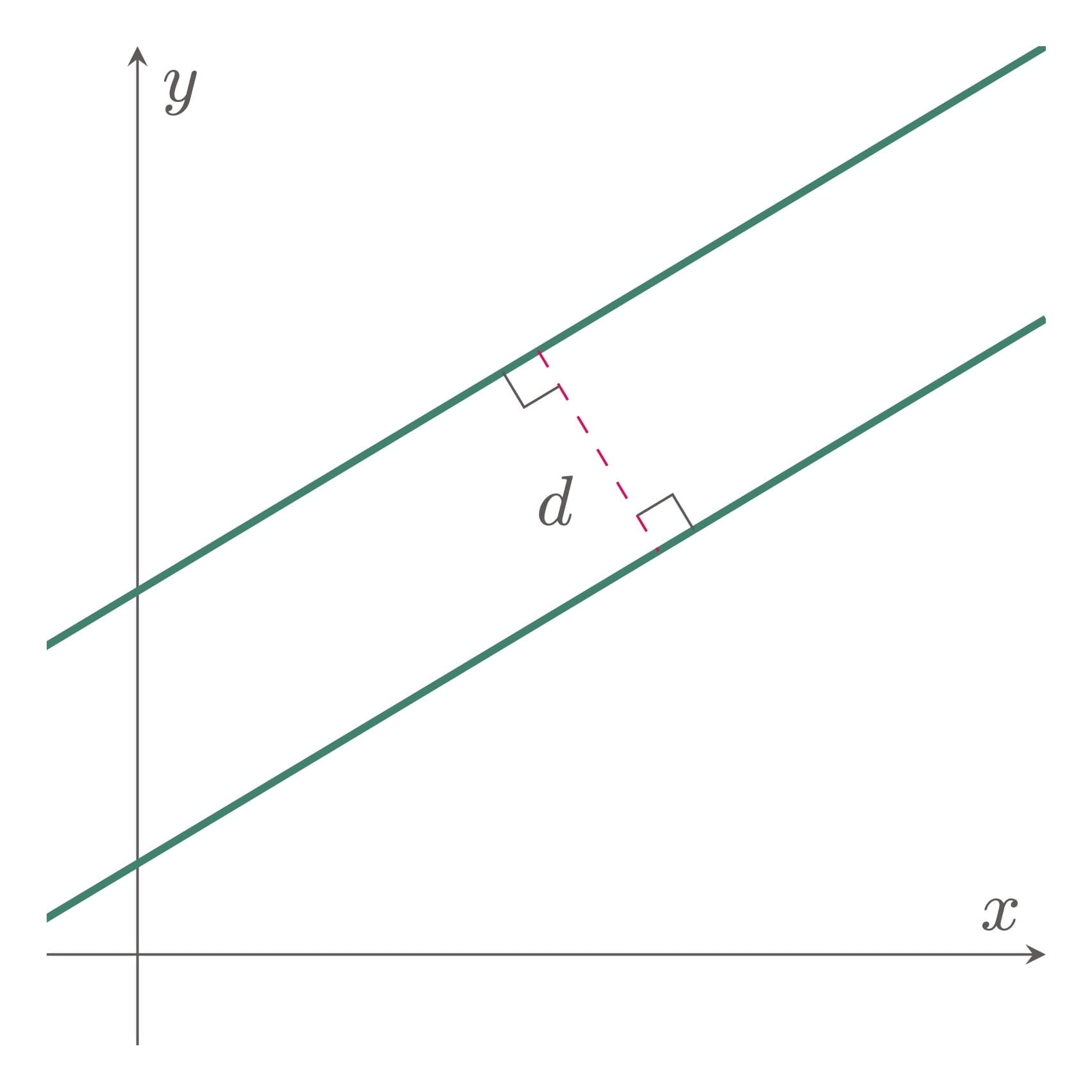
Figure 1: The shortest distance $d$ between two parallel lines is constant wherever it is measured.
Perpendicular Lines
Perpendicular lines are lines in a plane that intersect at a common point to form a right angle ($90^{\circ}$), as shown in Figure 2. Two non-vertical lines are perpendicular if their slopes are negative reciprocals of each other, that is, $m_2 = -\frac{1}{m_1}$.
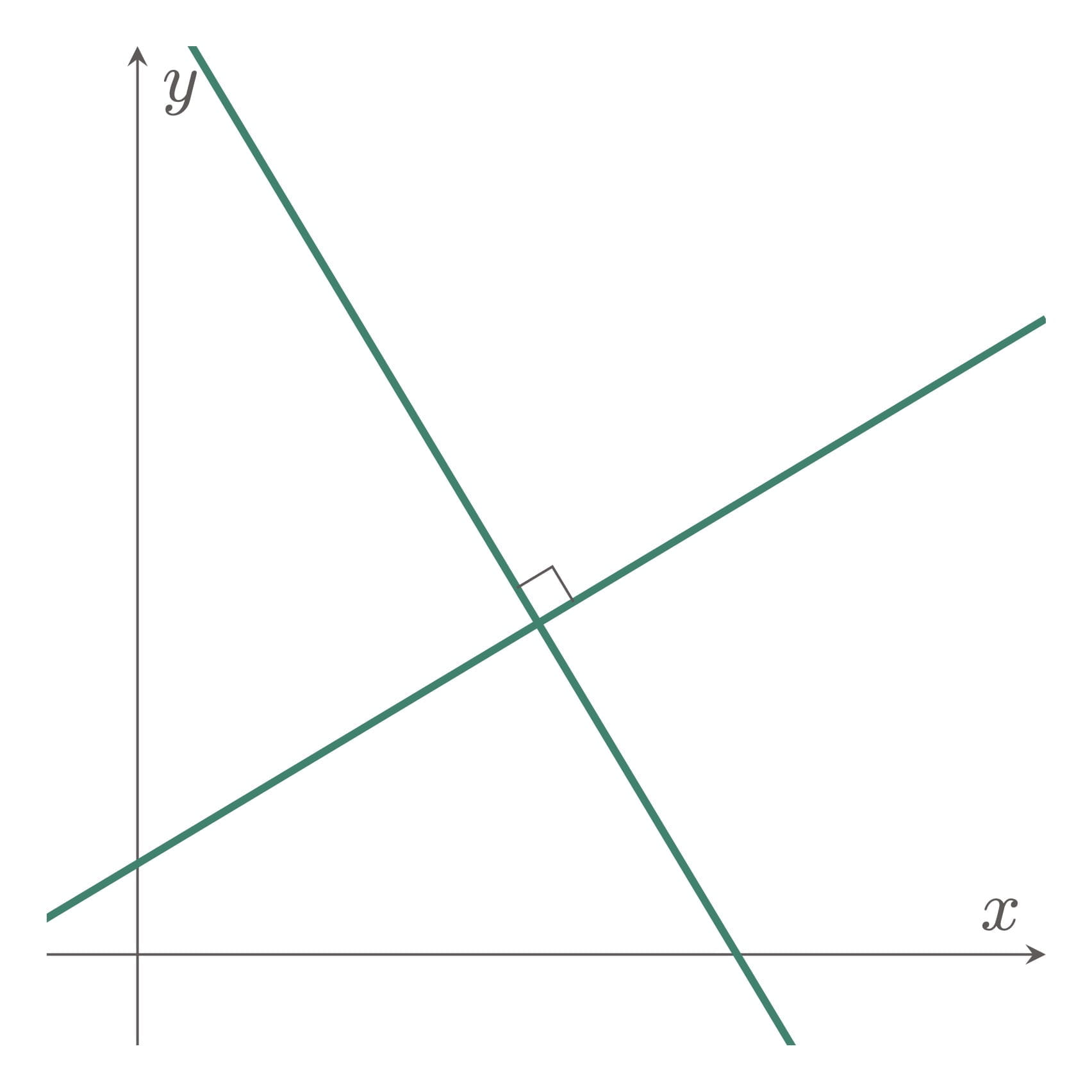
Figure 1: The angle formed by two perpendicular lines is $90^\circ$, and their slopes are the negative reciprocals of each other.
$\example{1}$ A line passes through $(2, 8)$ and parallel to the line through $(-2, 2)$ and $(4, 5)$. Find its equation.
$\solution$
Since the line that passes through $(2,8)$ is parallel to the line through $(-2, 2)$ and $(4, 5)$, their slopes are the same, so determine first the slope of the line using the Equation of the Slope
\[\begin{align*} m &= \frac{y_2-y_1}{x_2-x_1} \\ &= \frac{5-2}{4-(-2)} \\ &= \frac{3}{6} \\ &= \frac{1}{2} \end{align*}\]Then using the computed slope and the given point, the equation of the line can already be solved using the Point-Slope Form
\[\begin{align*} y-y_1 &= m(x-x_1) \\ y-8 &= \frac{1}{2}(x-2) \\ 2y-16 &= x-2 \\ x-2y+14 &= 0 \tagans \end{align*}\]$\example{2}$ Find the equation of the perpendicular bisector of the line joining $(3, 0)$ and $(-6, -3)$.
$\solution$
To determine the point where the segment is bisected, use the Midpoint Formula,
\[\begin{align*} P(x,y) &= \br{ \frac{x_1+x_2}{2},\frac{y_1+y_2}{2} } \\ &= \br{ \frac{3+(-6)}{2},\frac{0+(-3)}{2} } \\ &= \br{ -\frac{3}{2}, -\frac{3}{2} } \end{align*}\]Next, use Equation of the Slope to determine the slope of the segment,
\[\begin{align*} m &= \frac{y_2-y_1}{x_2-x_1} \\ &= \frac{-3-0}{-6-3} \\ &= \frac{-3}{-9} \\ &= \frac{1}{3} \end{align*}\]The slope of the perpendicular bisector is the negative reciprocal of this slope. Let $m_1=\frac{1}{3}$, then
\[\begin{align*} m_2 &= -\frac{1}{m_1} \\ &= -\frac{1}{1/3} \\ &= -3 \end{align*}\]Using the midpoint and $m_2$, apply the Point-Slope Form,
\[\begin{align*} y-y_1 &= m(x-x_1) \\ y-\br{ -\frac{3}{2} } &= -3\brk{ x-\br{ -\frac{3}{2} } } \\ y+\frac{3}{2} &= -3x-\frac{9}{2} \\ 3x+y+6 &= 0 \tagans \end{align*}\]