

Conic sections, or simply conics, are the curves formed when a plane intersects a double-napped right circular cone, which consists of two identical cones placed apex to apex and extending infinitely in both directions, as shown in Figure 1. The shape of the resulting curve depends entirely on the angle at which the plane cuts through the cone, which is why these curves are collectively called conic sections.
Conics have been studied since ancient Greece and remain one of the most widely applied curves in mathematics, science, and engineering. The orbits of planets are ellipses, the path of a projectile is a parabola, and the reflective surfaces of telescopes and satellite dishes are shaped using parabolas and hyperbolas.
A conic is classified as either degenerate or non-degenerate, depending on whether the plane passes through the apex of the cone. When the plane passes through the apex, the intersection produces a $\tcB{\text{degenerate conic}}$ such as a point, a single line, or two intersecting lines, rather than a proper curve. These are considered degenerate because they are limiting or collapsed cases of the four standard conics. When the plane does not pass through the apex, the result is a $\tcB{\text{non-degenerate conic}}$. Depending on the angle of the cutting plane, four distinct curves can be produced:
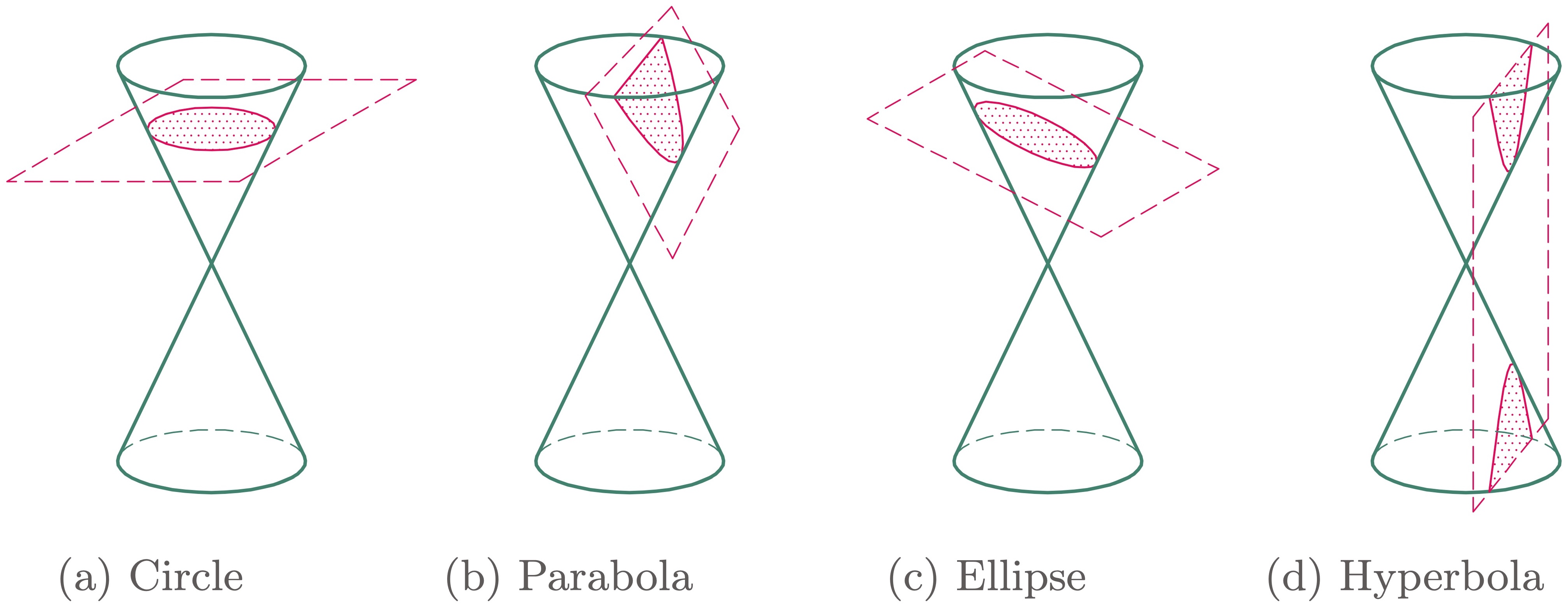
Figure 1: The four basic types of conics.
- A circle is formed when the cutting plane is perpendicular to the axis of the cone (Figure 1a).
- A parabola is formed when the cutting plane is parallel to exactly one side (slant edge) of the cone (Figure 1b.
- An ellipse is formed when the cutting plane is tilted at an angle that is not parallel to the axis, the base, or any side of the cone (Figure 1c).
- A hyperbola is formed when the cutting plane is parallel to the axis of the cone, cutting through both nappes (Figure 1d).
The circle is sometimes regarded as a special case of the ellipse, since it arises when the ellipse’s two defining distances become equal. Each of these curves has a precise algebraic description, which will be developed throughout this chapter. In the discussions that follow, we will concentrate exclusively on non-degenerate conics.
General Equation
The General Form of the Equation of a Conic Section is expressed as,
$$\begin{align} Ax^2+Bxy+Cy^2+Dx+Ey+F=0 \label{eq:2-pt} \end{align}$$
where $A, B, C, D, E,$ and $F$ are numerical coefficients of the equation. This equation is the algebraic definition of a conic.
$\example{1}$ Determine the numerical coefficients of the equation $6x^2 + 2xy - 5y^2 +6y - 2x + 6 = 0$
$\solution$
Rearrange the give equation in following the general form. Recall that the general form is: $Ax^2+Bxy+Cy^2+Dx+Ey+F=0$
\[\begin{align*} 6x^2 + 2xy - 5y^2 +6y - 2x + 6 &= 0 \\ 6x^2 + 2xy - 5y^2 - 2x + 6y + 6 &= 0 \end{align*}\]Identify the values of $A$ to $F$:
\[\begin{align*} A = 6; B = 2; C = - 5; D = - 2; E = 6; F = 6 \tagans \end{align*}\]$\example{2}$ Determine the numerical coefficients of the equation $y^2 - 3y + \frac{1}{2}x^2 + x = 5$
$\solution$
Rearrange the give equation in following the general form. Recall that the general form is: $Ax^2+Bxy+Cy^2+Dx+Ey+F=0$
\[\begin{align*} y^2 - 3y + \frac{1}{2}x^2 + x &= 5 \\ \frac{1}{2}x^2 + y^2 + x - 3y - 5 &= 0 \end{align*}\]Identify the values of $A$ to $F$: Since the $xy$ term is missing, $B = 0$.
\[\begin{align*} A = 1/2; B = 0; C = 1; D = 1; E = - 3; F = - 5 \tagans \end{align*}\]Classification by Inspection
When the general equation of a conic has no $xy$ term (i.e., $B = 0$), the type of conic can be quickly identified by simply examining the coefficients $A$ and $C$ of the squared terms. The following conditions apply:
- Circle: $A = C$ (coefficients of $x^2$ and $y^2$ are equal)
- Ellipse: $A \neq C$, but $A$ and $C$ have the same sign
- Parabola: $A = 0$ or $C = 0$ (only one squared term is present)
- Hyperbola: $A$ and $C$ have opposite signs
This method provides a quick classification directly from the equation without any computation. However, it only applies when $B = 0$. For equations involving an $xy$ term, the discriminant test discussed in the next section must be used instead.
$\example{3}$ Identify the type of conic represented by the equation $3x^2 + 3y^2 - 6x + 2y - 1 = 0$
$\solution$
Inspecting the equation, $A = 3$ and $C = 3$. Since $A = C$, the conic is a circle.
$\example{4}$ Identify the type of conic represented by the equation $4x^2 + 9y^2 - 16x + 18y - 11 = 0$
$\solution$
Inspecting the equation, $A = 4$ and $C = 9$. Since $A \neq C$ but both are positive (same sign), the conic is an ellipse.
$\example{5}$ Identify the type of conic represented by the equation $y^2 - 4x + 6y + 1 = 0$
$\solution$
Inspecting the equation, $A = 0$ and $C = 1$. Since $A = 0$, only one squared term is present, so the conic is a parabola.
$\example{6}$ Identify the type of conic represented by the equation $x^2 - 4y^2 + 2x + 8y - 7 = 0$
$\solution$
Inspecting the equation, $A = 1$ and $C = -4$. Since $A$ and $C$ have opposite signs, the conic is a hyperbola.
$\example{7}$ Identify the type of conic represented by the equation $-5x^2 - 5y^2 + 10x - 4y + 3 = 0$
$\solution$
Inspecting the equation, $A = -5$ and $C = -5$. Since $A = C$, the conic is a circle. Note that even though both coefficients are negative, the classification still holds as long as $A = C$.
$\example{8}$ Identify the type of conic represented by the equation $-3x^2 - 8y^2 + 6x - 4y - 2 = 0$
$\solution$
Inspecting the equation, $A = -3$ and $C = -8$. Since $A \neq C$ but both are negative (same sign), the conic is an ellipse.
$\example{9}$ Identify the type of conic represented by the equation $2x^2 + 2y^2 = 4x - 6y + 8$
$\solution$
The equation is not in general form. Rearranging,
\[\begin{align*} 2x^2 + 2y^2 - 4x + 6y - 8 &= 0 \end{align*}\]Inspecting the equation, $A = 2$ and $C = 2$. Since $A = C$, the conic is a circle.
$\example{10}$ Identify the type of conic represented by the equation $5x^2 = 3 - 3y^2 + 2x - 4y$
$\solution$
The equation is not in general form. Rearranging,
\[\begin{align*} 5x^2 + 3y^2 - 2x + 4y - 3 &= 0 \end{align*}\]Inspecting the equation, $A = 5$ and $C = 3$. Since $A \neq C$ but both are positive (same sign), the conic is an ellipse.
$\example{11}$ Identify the type of conic represented by the equation $x^2 + 6x = 4y - 5$
$\solution$
The equation is not in general form. Rearranging,
\[\begin{align*} x^2 - 4y + 6x + 5 &= 0 \end{align*}\]Inspecting the equation, $A = 1$ and $C = 0$. Since $C = 0$, only one squared term is present, so the conic is a parabola.
$\example{12}$ Identify the type of conic represented by the equation $x^2 + 2xy + y^2 - 4x + 2y = 0$
$\solution$
Inspecting the equation, $B = 2$. Since an $xy$ term is present, the type of conic cannot be determined by inspection of $A$ and $C$ alone. The discriminant test must be used instead, which will be discussed in the next section.
Discriminant Test
When the general equation of a conic contains an $xy$ term (i.e., $B \neq 0$), the classification by inspection no longer applies. In this case, the type of conic can be determined using the discriminant, $B^2 - 4AC$. Assuming that the conic is non-degenerate, the following conditions hold:
- If $B^2 - 4AC < 0$, the conic is a circle or an ellipse. (It is a circle if $B = 0$ and $A = C$; otherwise, it is an ellipse.)
- If $B^2 - 4AC = 0$, the conic is a parabola.
- If $B^2 - 4AC > 0$, the conic is a hyperbola.
Note that the discriminant test works for all conics regardless of whether $B = 0$ or not, making it the more general of the two classification methods.
$\example{13}$ Identify the type of conic represented by the equation $x^2+2xy-5y^2+6x-2y=0$
$\solution$
\[\begin{align*} \text{Inspecting the equation: } & x^2+2xy-5y^2+6x-2y=0 \\ \text{We can see that: } & A=1,\ B=2,\ C=-5 \end{align*}\]
Substituting into $B^2-4AC$:
\[\begin{align*} B^2-4AC &= (2)^2 - [(4)(1)(-5)] \\ &= 4 - [-20] \\ &= 24 \end{align*}\]Since the result is greater than zero, the conic is a hyperbola.
$\example{14}$ Identify the type of conic represented by the equation $x^2-2xy+2y^2-y=0$
$\solution$
\[\begin{align*} \text{Inspecting the equation: } & x^2-2xy+2y^2-y=0 \\ \text{We can see that: } & A=1,\ B=-2,\ C=2 \end{align*}\]
Substituting into $B^2-4AC$:
\[\begin{align*} B^2-4AC &= (-2)^2 - [(4)(1)(2)] \\ &= 4 - [8] \\ &= -4 \end{align*}\]Since the result is less than zero, the conic is an ellipse.
$\example{15}$ Identify the type of conic represented by the equation $x^2+4xy+4y^2-3x=20$
$\solution$
\[\begin{align*} \text{Inspecting the equation: } & x^2+4xy+4y^2-3x=20 \\ \text{We can see that: } & A=1,\ B=4,\ C=4$ \end{align*}\]
Substituting into $B^2-4AC$:
\[\begin{align*} B^2-4AC &= (4)^2 - [(4)(1)(4)] \\ &= 16 - [16] \\ &= 0 \end{align*}\]Since the result is equal to zero, the conic is a parabola.
Eccentricity
The eccentricity $(e)$ is a parameter that describes the shape of conic sections. It is a measure of how much the conic section deviates from being circular.
The eccentricity of a conic section is mathematically defined to be the ratio of the distance from any point on the conic section to its focus, to the perpendicular distance from that point to the nearest directrix. Note that the eccentricity is constant for any conic section, which is why this property can be used as a general definition (description) for conic sections. Hence, it can also be used to determine the type of conic section. The following are true for all non-degenerate conic sections:
- If $e = 0$, the conic is a circle
- If $e < 1$, the conic is an ellipse
- If $e = 1$, the conic is a parabola
- If $e > 1$, the conic is a hyperbola
The eccentricity of a circle is zero, because it is perfectly circular. It is also important to remember that two conic sections are considered similar (identically shaped) if and only if they have equal eccentricities. The concept of eccentricity will be further discussed in the succeeding lessons.