

A circle is one of the most familiar curves in geometry. Formally, it is defined as the set of all points on a plane that are equidistant from a fixed point called the center. The constant distance from the center to any point on the circle is called the radius. These two elements, the center and the radius, completely determine the size and position of a circle on the plane, and as we will see, they are also the key quantities in writing its equation.
Standard Form of the Equation of a Circle
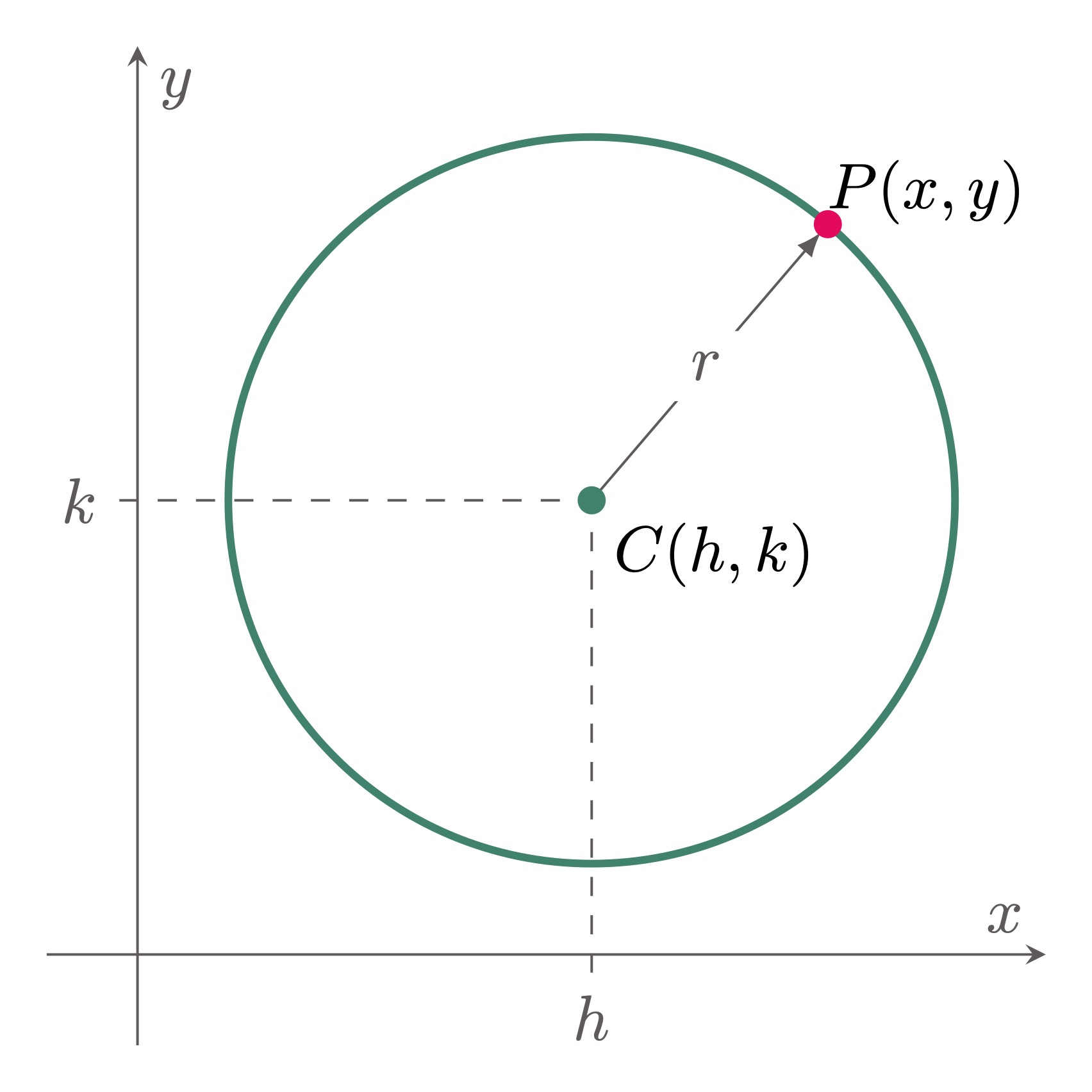
Figure 1: A Circle with center at $(h, k)$.
Consider a circle with center $C(h,k)$ and radius $r$, as shown in Figure 1. Let $P(x,y)$ be any point on the circle. Since the distance from the center $C$ to any point $P$ is always equal to $r$, applying the distance formula gives
\[r = \sqrt{(x-h)^2+(y-k)^2}\]Squaring both sides yields
$$\begin{align} (x-h)^2+(y-k)^2 = r^2 \label{eq:standard circle} \end{align}$$
Equation \ref{eq:standard circle} is called the standard form of the equation of a circle, where $(h,k)$ is the center and $r$ is the radius. When the center is at the origin, $h = 0$ and $k = 0$, and the equation simplifies to
$$\begin{align} x^2 + y^2 = r^2 \label{eq:standard circle origin} \end{align}$$
$\example{1}$ Determine the equation of the circle whose center is at the origin and has a radius of 6 units.
$\solution$
Since the center is at the origin, use Equation \ref{eq:standard circle origin},
\[\begin{align*} x^2 + y^2 &= r^2 \\ x^2 + y^2 &= 6^2 \\ x^2 + y^2 &= 36 \tagans \end{align*}\]$\example{2}$ Determine the equation of the circle whose center is at $(2,-4)$ and has a radius of 4 units.
$\solution$
Using Equation \ref{eq:standard circle}, substitute $h = 2$, $k = -4$, and $r = 4$,
\[\begin{align*} (x-h)^2 + (y-k)^2 &= r^2 \\ (x-2)^2 + [y-(-4)]^2 &= 4^2 \\ (x-2)^2 + (y+4)^2 &= 16 \tagans \end{align*}\]$\example{3}$ A circle has its center at $(3, -2)$ and one end of a diameter at $(5, 2)$. Determine the equation of the circle.
$\solution$
Since the given point is one end of a diameter and the center is known, the radius is simply the distance from the center to that endpoint. Using the distance formula,
\[\begin{align*} r &= \sqrt{(x-h)^2+(y-k)^2} \\ &= \sqrt{(5-3)^2+[2-(-2)]^2} \\ &= \sqrt{4 + 16} \\ &= \sqrt{20} \end{align*}\]Substituting the center $(3, -2)$ and $r = \sqrt{20}$ into Equation \ref{eq:standard circle},
\[\begin{align*} (x-h)^2 + (y-k)^2 &= r^2 \\ (x-3)^2 + [y-(-2)]^2 &= \br{\sqrt{20}}^2 \\ (x-3)^2 + (y+2)^2 &= 20 \tagans \end{align*}\]General Form of the Equation of a Circle
The general form of the equation of a circle can be derived by expanding the standard form (Equation \ref{eq:standard circle}),
\[\begin{align*} (x - h)^2 + (y - k)^2 &= r^2 \\ x^2 - 2hx + h^2 + y^2 - 2ky + k^2 &= r^2 \\ x^2 + y^2 - 2hx - 2ky + (h^2 + k^2 - r^2) &= 0 \end{align*}\]Letting $D = -2h$, $E = -2k$, and $F = h^2 + k^2 - r^2$, the equation becomes
$$\begin{align} x^2 + y^2 + Dx + Ey + F = 0 \label{eq:general circle} \end{align}$$
Equation \ref{eq:general circle} is called the general form of the equation of a circle, where $D$, $E$, and $F$ are constants. Notice that the coefficients of $x^2$ and $y^2$ are both equal to 1, which is consistent with the classification by inspection discussed earlier — a circle always has $A = C$, and $B = 0$. This is also reflected in its eccentricity: a circle has $e = 0$, meaning it does not deviate from its circular shape at all.
Given an equation in general form, the center and radius can be recovered by rewriting the equation back into standard form through completing the square, as illustrated in the following examples.
$\example{4}$ Determine the center and the radius of the circle defined by the equation $x^2+y^2-6x-4y-12=0$.
$\solution$
To find the center and radius, rewrite the equation in standard form by completing the square. Begin by grouping terms with the same variable and moving the constant to the right,
\[\begin{align*} (x^2-6x) + (y^2-4y) &= 12 \end{align*}\]Add to each group the square of half the linear coefficient, and add the same values to the right side to keep the equation balanced,
\[\begin{align*} (x^2-6x+9) + (y^2-4y+4) &= 12 + 9 + 4 \\ (x-3)^2 + (y-2)^2 &= 25 \end{align*}\]Comparing with Equation \ref{eq:standard circle}, the center and radius are
\[\begin{align*} C(3, 2) \quad \text{and} \quad r = 5 \tagans \end{align*}\]$\example{5}$ Determine the value of $k$ for which the equation $x^2+y^2+4x-2y-k=0$ represents a point circle.
$\solution$
A point circle is a degenerate case of the circle in which the radius is zero, so the graph reduces to a single point. To find $k$, first rewrite the equation in standard form by completing the square,
\[\begin{align*} (x^2+4x) + (y^2-2y) &= k \\ (x^2+4x+4) + (y^2-2y+1) &= k + 5 \\ (x+2)^2 + (y-1)^2 &= k+5 \end{align*}\]For the equation to represent a point circle, the right side must equal zero,
\[\begin{align*} k + 5 &= 0 \\ k &= -5 \tagans \end{align*}\]