

A parabola is one of the most commonly encountered conic sections, appearing in contexts ranging from the trajectory of a projectile to the reflective surface of a satellite dish. Formally, a parabola is defined as the set of all points on a plane that are equidistant from a fixed point called the focus and a fixed line called the directrix. The line passing through the focus and perpendicular to the directrix is called the axis of symmetry, and the point on the axis midway between the focus and the directrix is called the vertex. The vertex is also the point where the parabola changes direction, as illustrated in Figure 1.
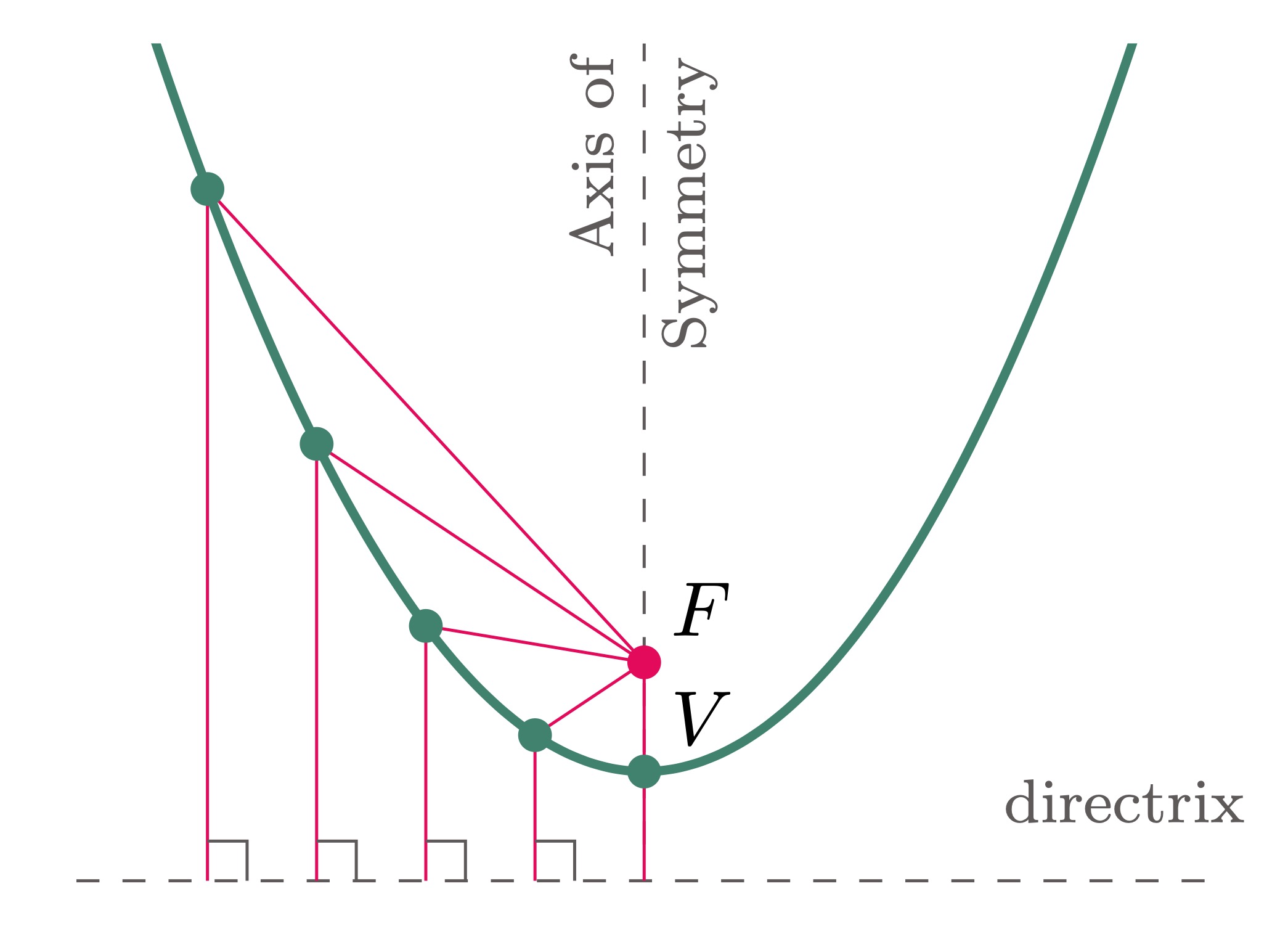
Figure 1: A parabola showing equal distances from each point on the curve to the focus $F$ and to the directrix.
A parabola can open in four possible directions: upward, downward, to the right, or to the left, as shown in Figure 2. Each orientation produces a different relationship between the vertex, focus, and directrix, and consequently a different standard equation.
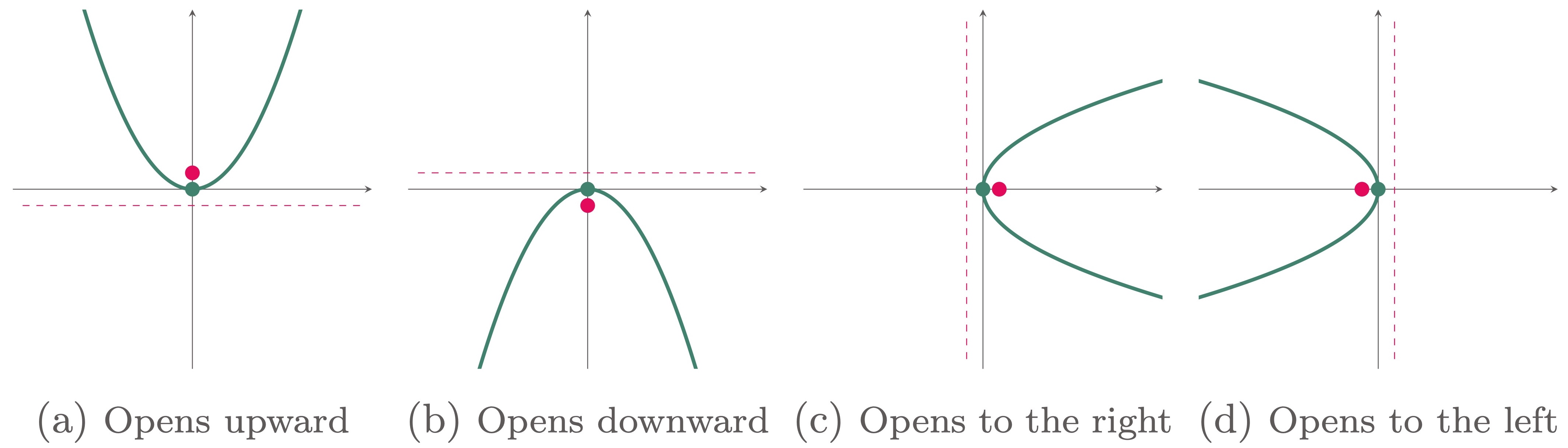
Figure 2: The four possible orientations of a parabola, each with its focus $F$ and directrix.
Standard Form of the Equation of a Parabola
To derive the standard form, consider a parabola with its vertex at the origin opening upward, as shown in Figure 3. Let $a > 0$ be the distance from the vertex to the focus, so the focus is at $F(0, a)$ and the directrix is the line $y = -a$. Let $P(x, y)$ be any point on the parabola.
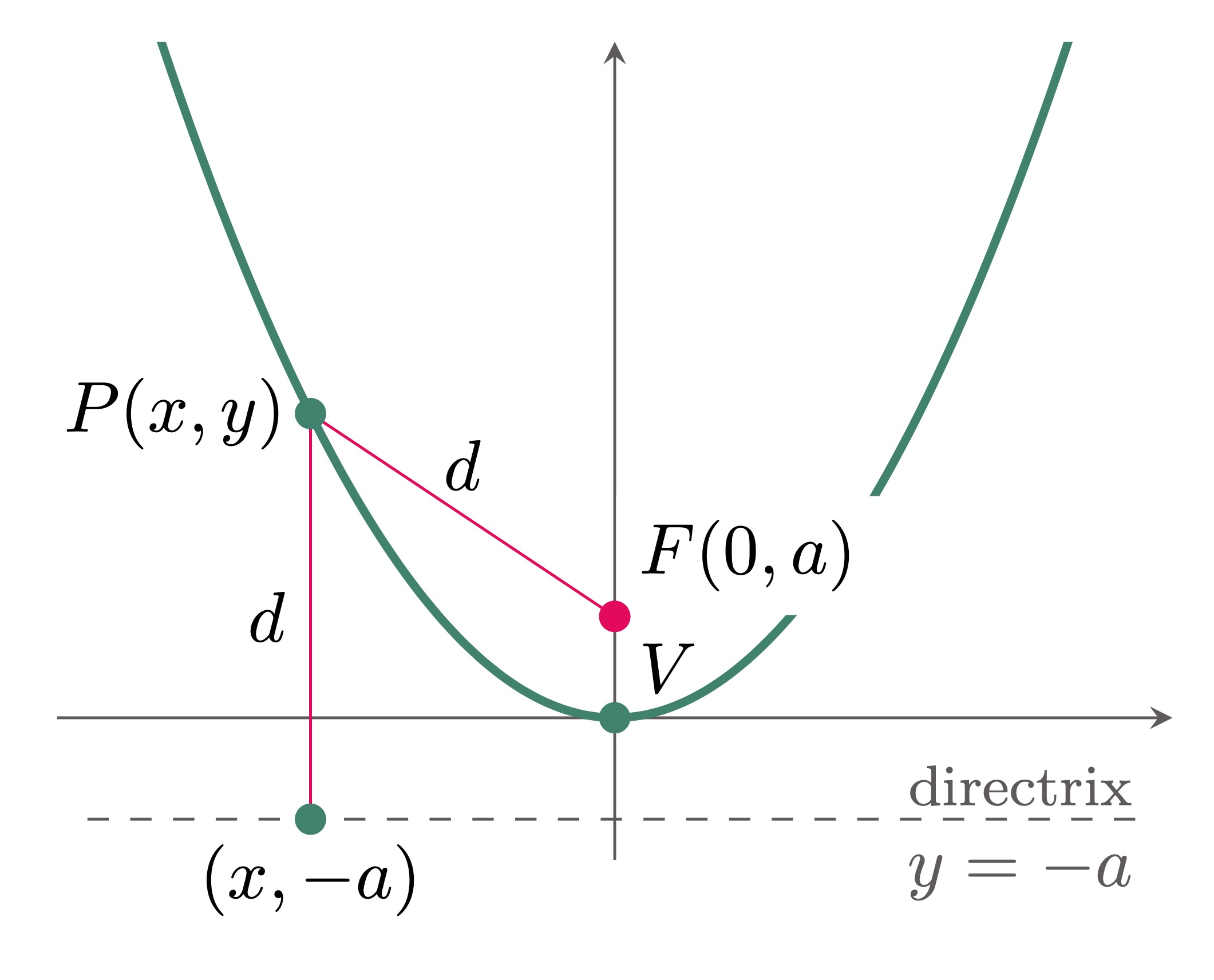
Figure 3: Parabola opening upward with vertex at the origin, focus $F(0,a)$, and directrix $y = -a$.
By definition, the distance from $P$ to the focus must equal the distance from $P$ to the directrix. Setting these distances equal and applying the distance formula,
\[\begin{align*} \sqrt{(x-0)^2+(y-a)^2} &= \sqrt{(x-x)^2+[y-(-a)]^2} \\ \sqrt{x^2+(y-a)^2} &= \sqrt{(y+a)^2} \end{align*}\]Squaring both sides,
\[\begin{align*} x^2+(y-a)^2 &= (y+a)^2 \\ x^2+y^2-2ay+a^2 &= y^2+2ay+a^2 \\ x^2 &= 4ay \end{align*}\]The equation $x^2 = 4ay$ is the standard form of a parabola that opens upward with vertex at the origin. By applying the same approach to the remaining three orientations, the following standard forms are obtained:
$$\begin{align} & \tcB{\text{Orientation}} && \tcB{\text{Standard Form}} \nonumber\\ \hline & \text{Opens upward} && \phantom{aa} x^2=4ay \label{eqn:par 0 U}\\ & \text{Opens downward} && \phantom{aa} x^2=-4ay \label{eqn:par 0 D}\\ & \text{Opens to the right} && \phantom{aa} y^2=4ax \label{eqn:par 0 R}\\ & \text{Opens to the left} && \phantom{aa} y^2=-4ax \label{eqn:par 0 L} \end{align}$$
where $a > 0$ is the distance from the vertex to the focus, which is equal to the distance from the vertex to the directrix.
When the vertex is not at the origin but at a point $(h, k)$, as in Figure 4a, the standard equations can be obtained by translating the coordinate axes. Consider Figure 4b, where the axes are shifted from the origin $O$ to the new origin $O’$ at the point $(h, k)$. If $X$ and $Y$ denote the coordinates of a point relative to the new axes, then the relationships between the old and new coordinates are
\[\begin{align*} X = x - h \qquad \text{and} \qquad Y = y - k \end{align*}\]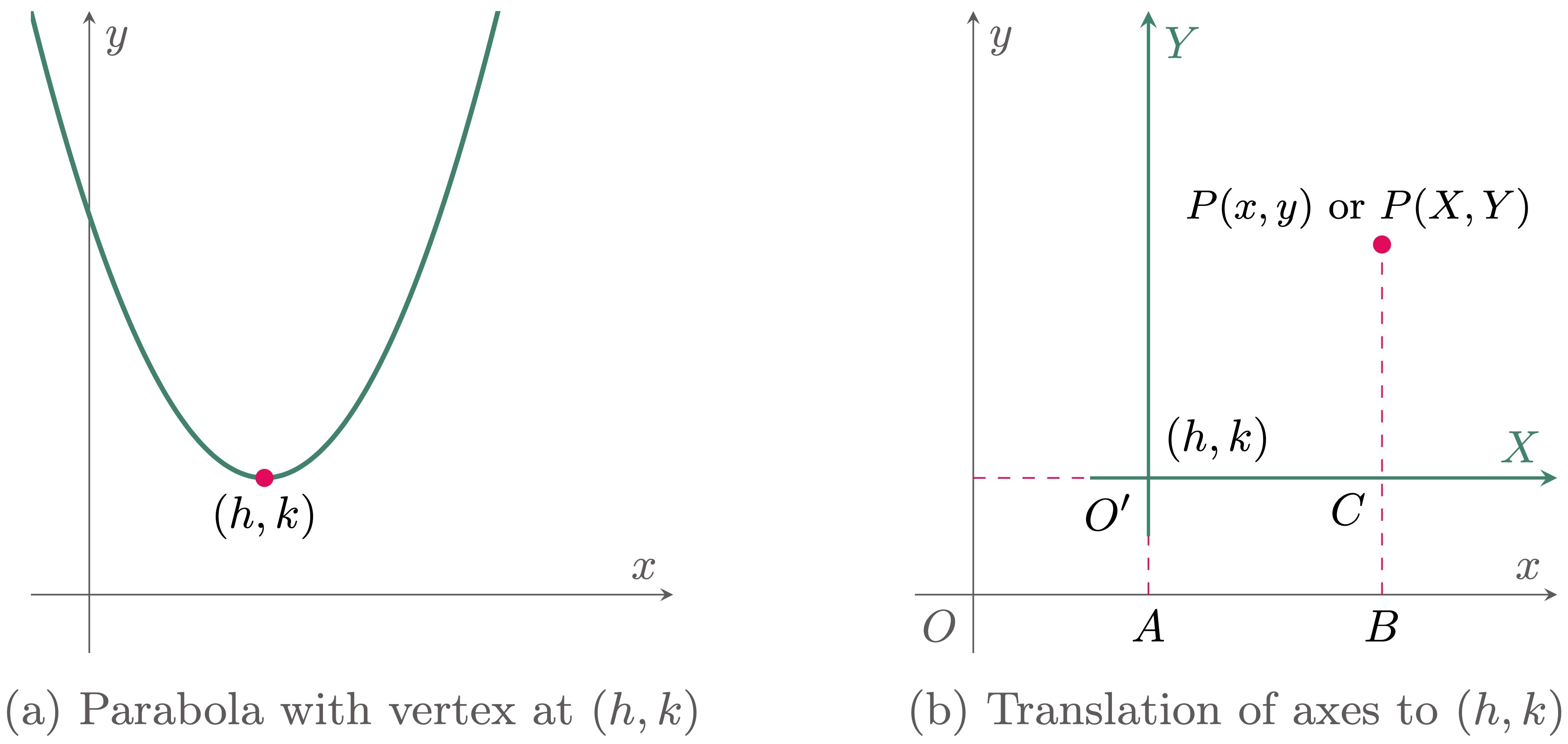
Figure 4: Shifting the vertex of a parabola from the origin to an arbitrary point $(h,k)$
Substituting $X = x-h$ and $Y = y-k$ into the standard forms for vertex at the origin gives the standard forms for a parabola with vertex at $(h, k)$:
$$\begin{align} & \tcB{\text{Orientation}} && \tcB{\text{Standard Form}} \nonumber\\ \hline & \text{Opens upward} && (x-h)^2=4a(y-k) \label{eqn:par hk U}\\ & \text{Opens downward} && (x-h)^2=-4a(y-k) \label{eqn:par hk D}\\ & \text{Opens to the right} && (y-k)^2=4a(x-h) \label{eqn:par hk R}\\ & \text{Opens to the left} && (y-k)^2=-4a(x-h) \label{eqn:par hk L} \end{align}$$
$\example{1}$ Write the equation (in standard form) of the parabola given the following characteristics:
- vertex at origin; focus is 2 units to the left of the vertex
- vertex at $(-3, 0)$; focus at $(0, 0)$
- focus at $(2, -2)$; equation of directrix is $y=5$
$\solution$
$\For{a}$ Since the focus is to the left of the vertex, the parabola opens to the left. Using Equation \ref{eqn:par 0 L} with $a = 2$,
\[\begin{align*} y^2 &= -4ax \\ y^2 &= -4(2)x \\ y^2 &= -8x \tagans \end{align*}\]$\For{b}$ Since the focus $(0, 0)$ is to the right of the vertex $(-3, 0)$, the parabola opens to the right. The distance from the vertex to the focus gives $a = 3$. Using Equation \ref{eqn:par hk R},
\[\begin{align*} (y-k)^2 &= 4a(x-h) \\ (y-0)^2 &= 4(3)[x-(-3)] \\ y^2 &= 12(x+3) \tagans \end{align*}\]$\For{c}$ Since the directrix is a horizontal line and the focus $(2, -2)$ lies below the directrix $y = 5$, the parabola opens downward.
The vertex lies midway between the focus and the directrix along the axis of symmetry. The vertical distance between them is $5 - (-2) = 7$, so the vertex is $\frac{7}{2}$ units from each, giving $a = \frac{7}{2}$ and vertex $V\left(2, \frac{3}{2}\right)$.
Using Equation \ref{eqn:par hk D},
\[\begin{align*} (x-h)^2 &= -4a(y-k) \\ (x-2)^2 &= -4\br{\frac{7}{2}}\br{y - \frac{3}{2}} \\ (x-2)^2 &= -14\br{y - \frac{3}{2}} \tagans \end{align*}\]General Form of the Equation of a Parabola
The general form of the equation of a parabola can be derived by expanding its standard form. Unlike the standard form, the general form does not immediately reveal the vertex, focal distance, or orientation of the parabola. Since exactly one of the squared terms is present in any parabola (either $x^2$ or $y^2$, but not both), the general form takes one of two possible forms:
$$\begin{align} Ax^2 + Dx + Ey + F = 0 \label{eqn:par GE 1} \\ \text{or} \nonumber \\ Cy^2 + Dx + Ey + F = 0 \label{eqn:par GE 2} \end{align}$$
Equation \ref{eqn:par GE 1} describes a parabola that opens upward or downward, while Equation \ref{eqn:par GE 2} describes a parabola that opens to the right or to the left. This is also consistent with the eccentricity of a parabola, $e = 1$, which requires that one of $A$ or $C$ is always zero. To recover the vertex and other properties from the general form, the equation must be rewritten in standard form by completing the square.
$\example{2}$ Determine the coordinates of the vertex and the focus of the parabola $x^2 - 4x - 8y + 12 = 0$.
$\solution$
The equation is second degree in $x$, so it matches Equation \ref{eqn:par GE 1}, meaning the parabola opens either upward or downward. Rewriting in standard form by completing the square,
\[\begin{align*} x^2 - 4x - 8y + 12 &= 0 \\ x^2 - 4x &= 8y - 12 \\ x^2 - 4x + 4 &= 8y - 12 + 4 \\ (x-2)^2 &= 8(y-1) \end{align*}\]Comparing with Equation \ref{eqn:par hk U}, the vertex is at $(h, k)$, so
\[\begin{align*} V(2, 1) \tagans \end{align*}\]Since $4a = 8$, then $a = 2$. The positive right-hand side confirms the parabola opens upward, so the focus is located $a = 2$ units above the vertex,
\[\begin{align*} F(2, 3) \tagans \end{align*}\]Latus Rectum of a Parabola
The latus rectum is a chord that passes through the focus and is parallel to the directrix. Its endpoints lie on the curve. Consider Figure 5. Since any point on the parabola is equidistant from the focus and the directrix, each endpoint of the latus rectum is $2a$ from the directrix and therefore also $2a$ from the focus. Since the parabola is symmetric about its axis, the latus rectum extends $2a$ on each side of the focus, giving a total length of
$$\begin{align} LR = 4a \end{align}$$
Note that $4a$ is precisely the absolute value of the coefficient of the linear term in the standard form of the equation of a parabola, so the length of the latus rectum can be read directly from the standard form without additional computation.
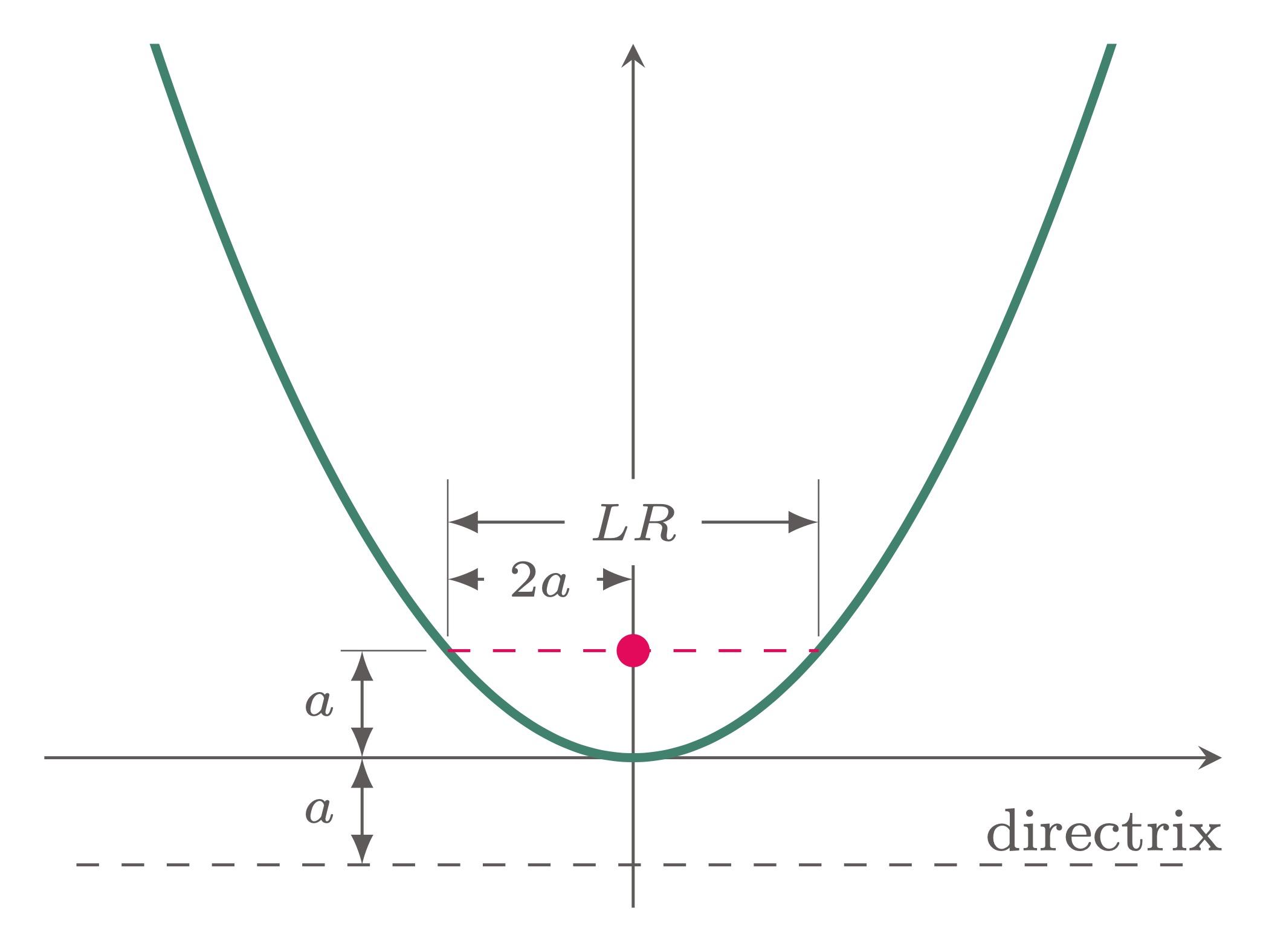
Figure 5: Latus rectum of a parabola.
$\example{3}$ Calculate the length of the latus rectum of the parabola $2y^2 - x + 12y + 16 = 0$.
$\solution$
The equation is second degree in $y$, so it matches Equation \ref{eqn:par GE 2}, meaning the parabola opens either to the right or to the left. Rewriting in standard form by completing the square,
\[\begin{align*} 2y^2 - x + 12y + 16 &= 0 \\ 2y^2 + 12y &= x - 16 \\ 2(y^2 + 6y) &= x - 16 \\ y^2 + 6y &= \frac{1}{2}x - 8 \\ y^2 + 6y + 9 &= \frac{1}{2}x - 8 + 9 \\ (y+3)^2 &= \frac{1}{2}(x+2) \end{align*}\]Comparing with Equation \ref{eqn:par hk R}, the coefficient of the linear term is $\frac{1}{2}$, so
\[\begin{align*} LR = 4a = \frac{1}{2} \tagans \end{align*}\]Eccentricity of a Parabola
In Introduction to Conic Sections, eccentricity was defined as the ratio of the distance from any point on the conic to its focus, to the perpendicular distance from that point to the nearest directrix. Taking the vertex of a parabola as the reference point, its distance to the focus is $a$ and its distance to the directrix is also $a$. Hence, the eccentricity of a parabola is always equal to one,
\[\begin{align*} e = \frac{\text{distance to focus}}{\text{distance to directrix}} = \frac{a}{a} = 1 \end{align*}\]