

An ellipse is the set of all points on a plane such that the sum of their distances from two fixed points is constant. Each fixed point is called a focus of the ellipse (plural: foci). Every ellipse has two axes of symmetry that are perpendicular to each other at a point called the center. The longer axis is called the major axis and the shorter axis is called the minor axis. The endpoints of the major axis are called the vertices of the ellipse, and the endpoints of the minor axis are called the co-vertices. The foci always lie on the major axis, as illustrated in Figure 1a.
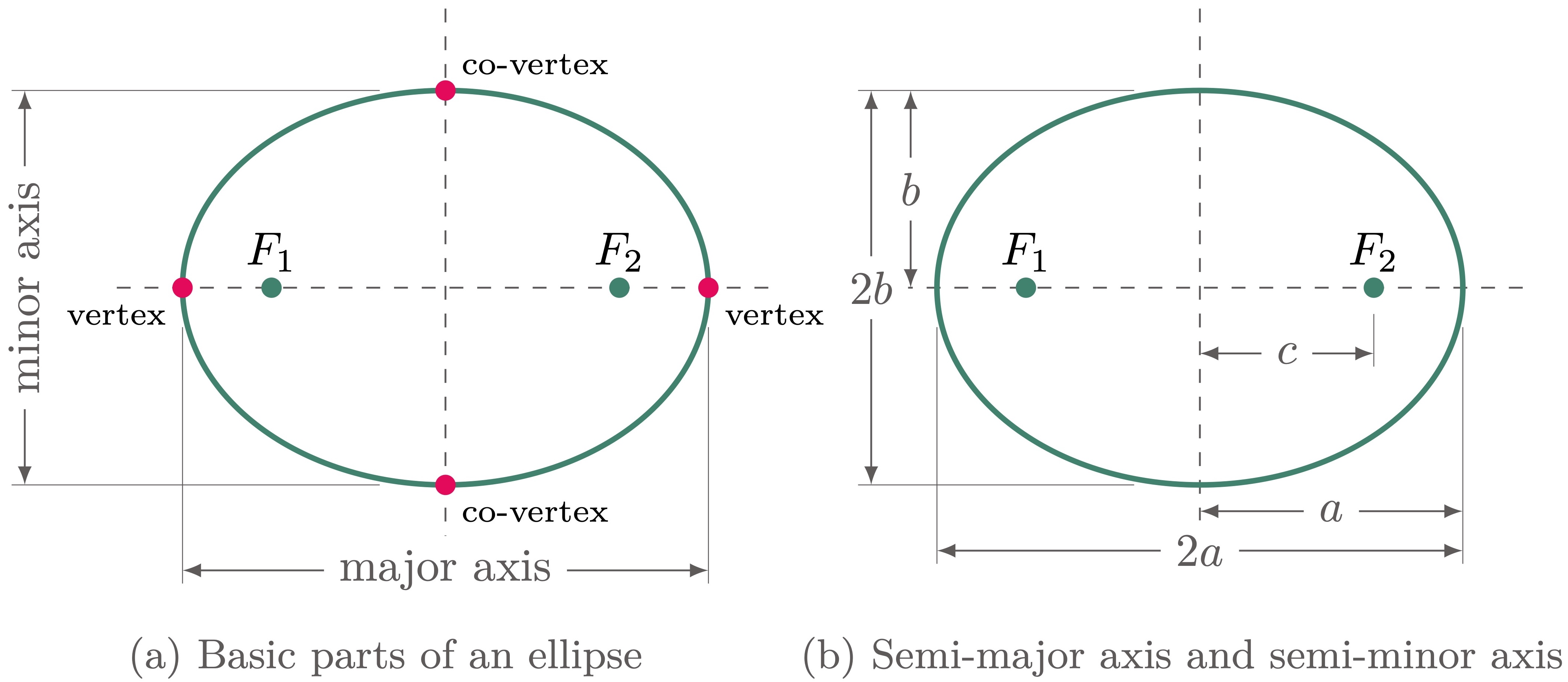
Figure 1: Basic parts and dimensions of an ellipse
The half-lengths of the axes are given special names. The semi-major axis, denoted by $a$, is half the length of the major axis, and the semi-minor axis, denoted by $b$, is half the length of the minor axis, as shown in Figure 1b. These two quantities, together with the distance from the center to each focus $c$, are related by
$$\begin{align} a^2 = b^2 + c^2 \label{eq:ellipse relation} \end{align}$$
This relationship can be understood geometrically: when a point on the ellipse is taken at the end of the minor axis, its distances to the two foci are both equal to $a$, forming a right triangle with legs $b$ and $c$ and hypotenuse $a$.
In this lesson, we will only consider ellipses whose axes are horizontal or vertical. An ellipse with a horizontal major axis is said to be wider than tall, while one with a vertical major axis is taller than wide. In both cases, the standard form of the equation and the positions of the foci and vertices follow directly from the orientation of the major axis, as discussed in the next subsection.
Standard Form of the Equation of an Ellipse
To derive the standard form, consider the ellipse shown in Figure 2, with center at the origin and major axis along the $x$-axis. The key parameters are:
- $c$ — distance from the center to each focus, giving foci at $F’(-c, 0)$ and $F(c, 0)$
- $a$ — distance from the center to each vertex, giving vertices at $P(a, 0)$ and $P’(-a, 0)$
- $b$ — distance from the center to each co-vertex, giving co-vertices at $Q(0, b)$ and $Q’(0, -b)$
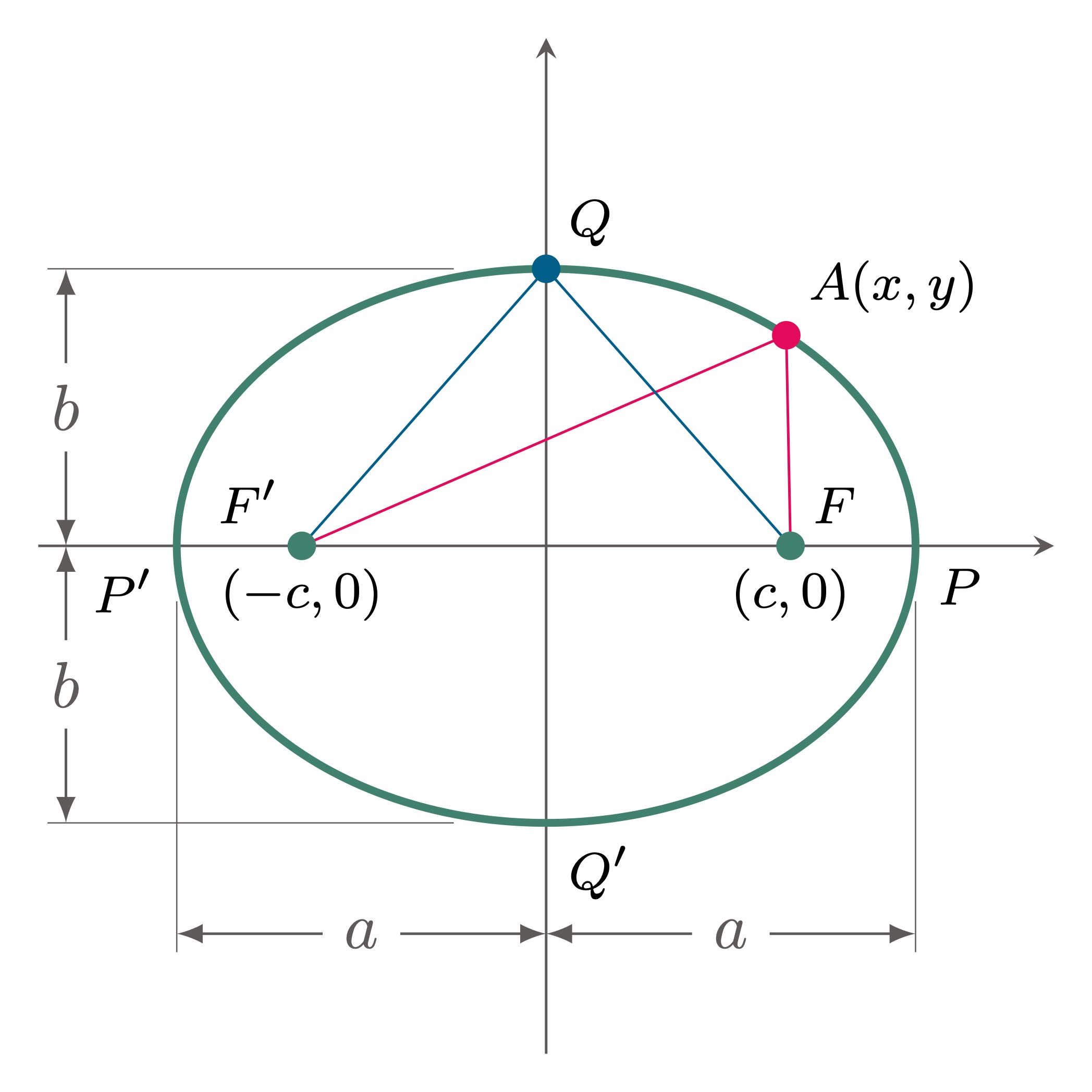
Figure 2: Ellipse with center at the origin and horizontal major axis.
By definition, the sum of the distances from any point on the ellipse to the two foci is constant. Taking the vertex $P(a, 0)$ as a reference point, this constant sum is: \(d_{PF} + d_{PF'} = (a-c) + (a+c) = 2a\)
So the constant sum equals $2a$, which is also the total length of the major axis. Now consider an arbitrary point $A(x, y)$ on the ellipse. Applying the distance formula, the defining condition becomes: \(\sqrt{(x-c)^2+y^2} + \sqrt{(x+c)^2+y^2} = 2a\)
Isolating one radical and squaring both sides,
\[\begin{align*} \sqrt{(x-c)^2+y^2} &= 2a - \sqrt{(x+c)^2+y^2} \\ (x-c)^2+y^2 &= 4a^2 - 4a\sqrt{(x+c)^2+y^2} + (x+c)^2 + y^2 \\ x^2-2cx+c^2 &= 4a^2 - 4a\sqrt{(x+c)^2+y^2} + x^2+2cx+c^2 \\ 4a\sqrt{(x+c)^2+y^2} &= 4a^2 + 4cx \end{align*}\]Dividing both sides by $4a$ and squaring again,
\[\begin{align*} (x+c)^2+y^2 &= \br{a + \frac{cx}{a}}^2 \\ x^2+2cx+c^2+y^2 &= a^2+2cx+\frac{c^2x^2}{a^2} \end{align*}\]Simplifying,
\[\begin{align*} x^2 - \frac{c^2x^2}{a^2} + y^2 &= a^2 - c^2 \\ \br{\frac{a^2-c^2}{a^2}}x^2 + y^2 &= a^2 - c^2 \end{align*}\]Dividing both sides by $a^2 - c^2$,
\[\begin{align*} \frac{x^2}{a^2} + \frac{y^2}{a^2-c^2} &= 1 \end{align*}\]Referring back to Figure 2, the line segments from $Q(0,b)$ to each focus form a right triangle with hypotenuse $a$ and legs $b$ and $c$. Applying the Pythagorean theorem gives $b^2 = a^2 - c^2$, which is the same relationship introduced in Equation~\ref{eq:ellipse relation}. Substituting,
\[\begin{align*} \frac{x^2}{a^2} + \frac{y^2}{b^2} = 1 \end{align*}\]This is the standard form of the equation of an ellipse with center at the origin and a horizontal major axis. Applying the same derivation for a vertical major axis, the standard forms for both orientations are:
$$\begin{align} & \tcB{\text{Orientation}} && \tcB{\text{Standard Form}} \nonumber\\ \hline \nonumber \\[-15pt] & \text{Horizontal major axis} && \phantom{a}\frac{x^2}{a^2}+\frac{y^2}{b^2}=1 \label{eqn:ellip 0 1}\\ & \text{Vertical major axis} && \phantom{a}\frac{x^2}{b^2}+\frac{y^2}{a^2}=1 \label{eqn:ellip 0 2} \end{align}$$
where $a > b > 0$ in both cases. Note that the larger denominator $a^2$ always corresponds to the axis along which the major axis lies.
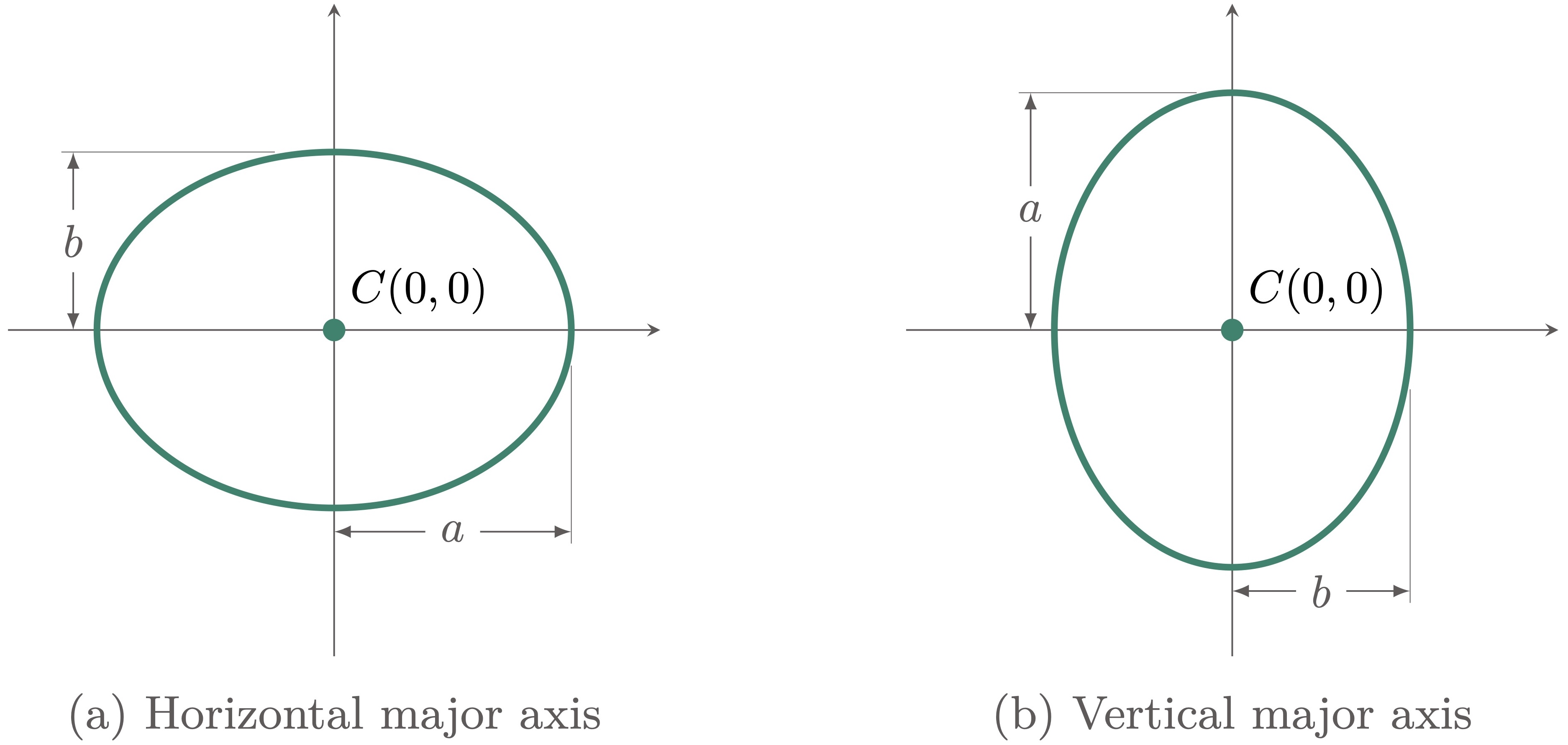
Figure 3: Standard forms of the ellipse with center at the origin.
For an ellipse whose center is at $(h, k)$, the standard forms are obtained by translation of axes, as discussed in Parabola:
$$\begin{align} & \tcB{\text{Orientation}} && \tcB{\phantom{aaaa}\text{Standard Form}} \nonumber\\ \hline \nonumber \\[-15pt] & \text{Horizontal major axis} && \frac{(x-h)^2}{a^2}+\frac{(y-k)^2}{b^2}=1 \label{eqn:ellip hk 1}\\ & \text{Vertical major axis} && \frac{(x-h)^2}{b^2}+\frac{(y-k)^2}{a^2}=1 \label{eqn:ellip hk 2} \end{align}$$
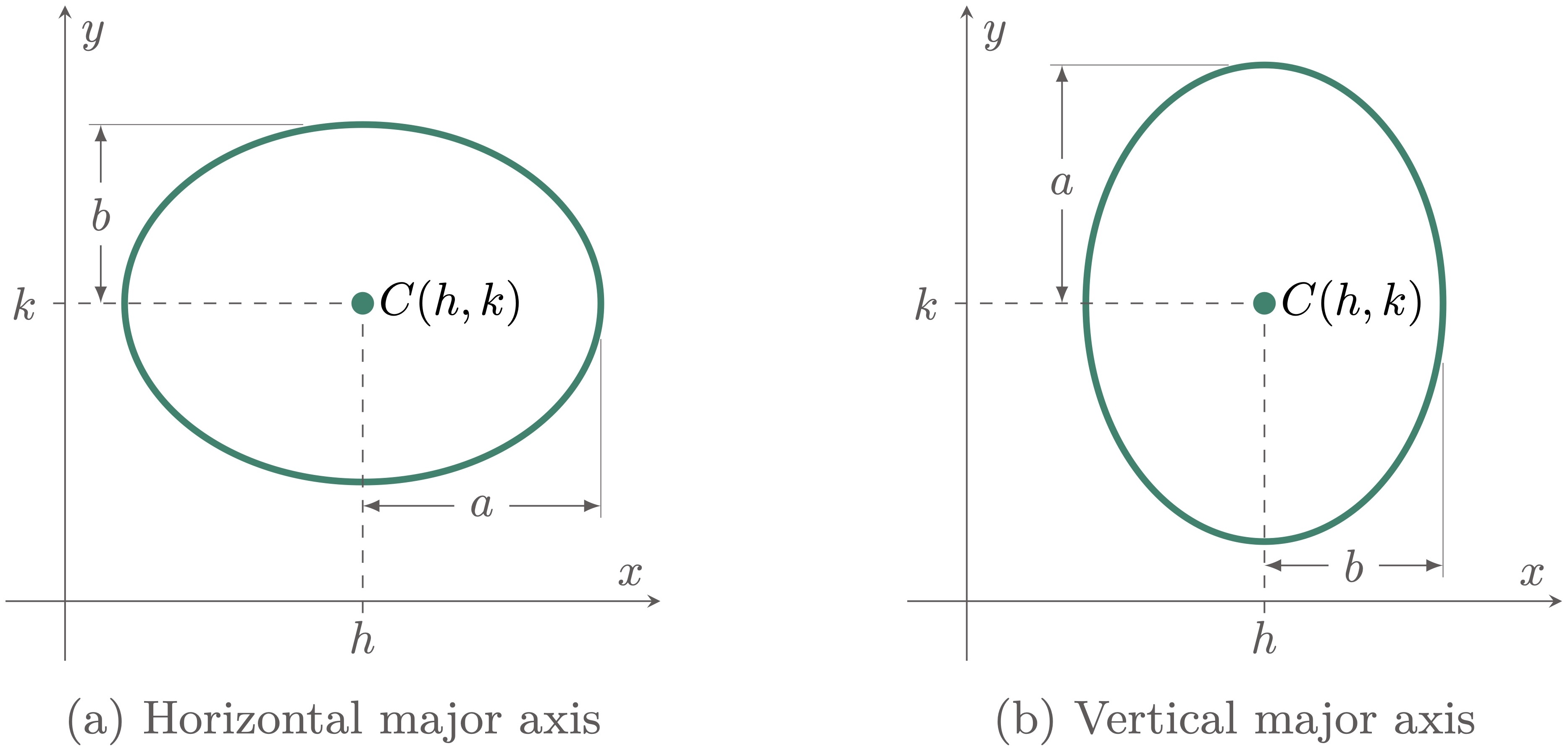
Figure 4: Standard forms of the ellipse with center at $C(h,k)$.
$\example{1}$ Determine the standard form of the equation of the ellipse with vertices $(\pm 8, 0)$ and foci $(\pm 5, 0)$.
$\solution$
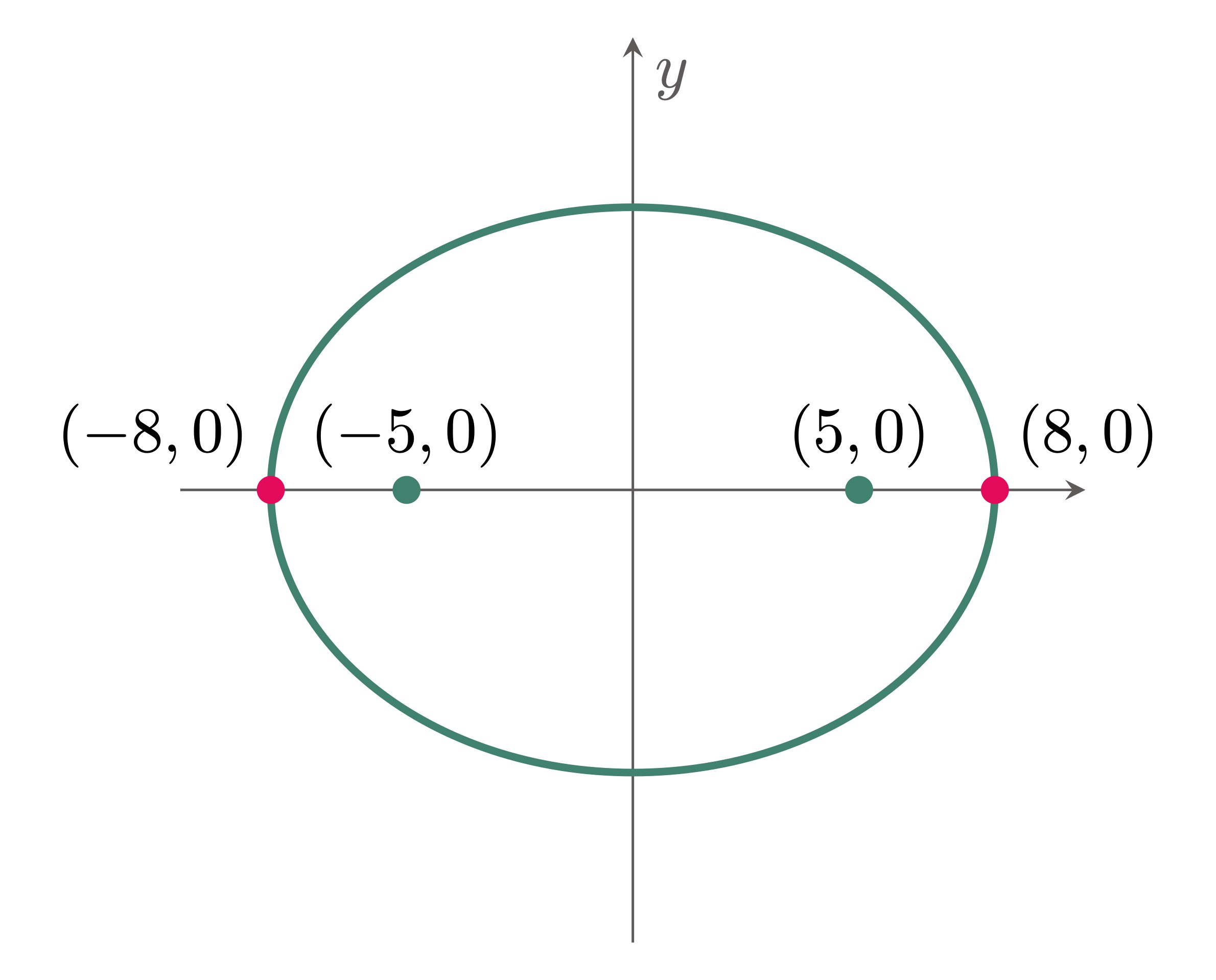
Since both the vertices and foci are symmetric about the $y$-axis and lie on the $x$-axis, the ellipse has its center at the origin with a horizontal major axis. Using Equation~\ref{eqn:ellip 0 1}, \(\frac{x^2}{a^2} + \frac{y^2}{b^2} = 1\)
Since the center is at the origin, the semi-major axis is $a = 8$ and the distance from the center to each focus is $c = 5$. Using Equation~\ref{eq:ellipse relation},
\[\begin{align*} b^2 &= a^2 - c^2 \\ &= (8)^2 - (5)^2 \\ &= 39 \end{align*}\]Substituting $a^2 = 64$ and $b^2 = 39$ into the standard form,
\[\begin{align*} \frac{x^2}{64} + \frac{y^2}{39} = 1 \tagans \end{align*}\]$\example{2}$ Determine the standard form of the equation of the ellipse with vertices $(2, -8)$ and $(2, 2)$, and foci $(2, -7)$ and $(2, 1)$.
$\solution$
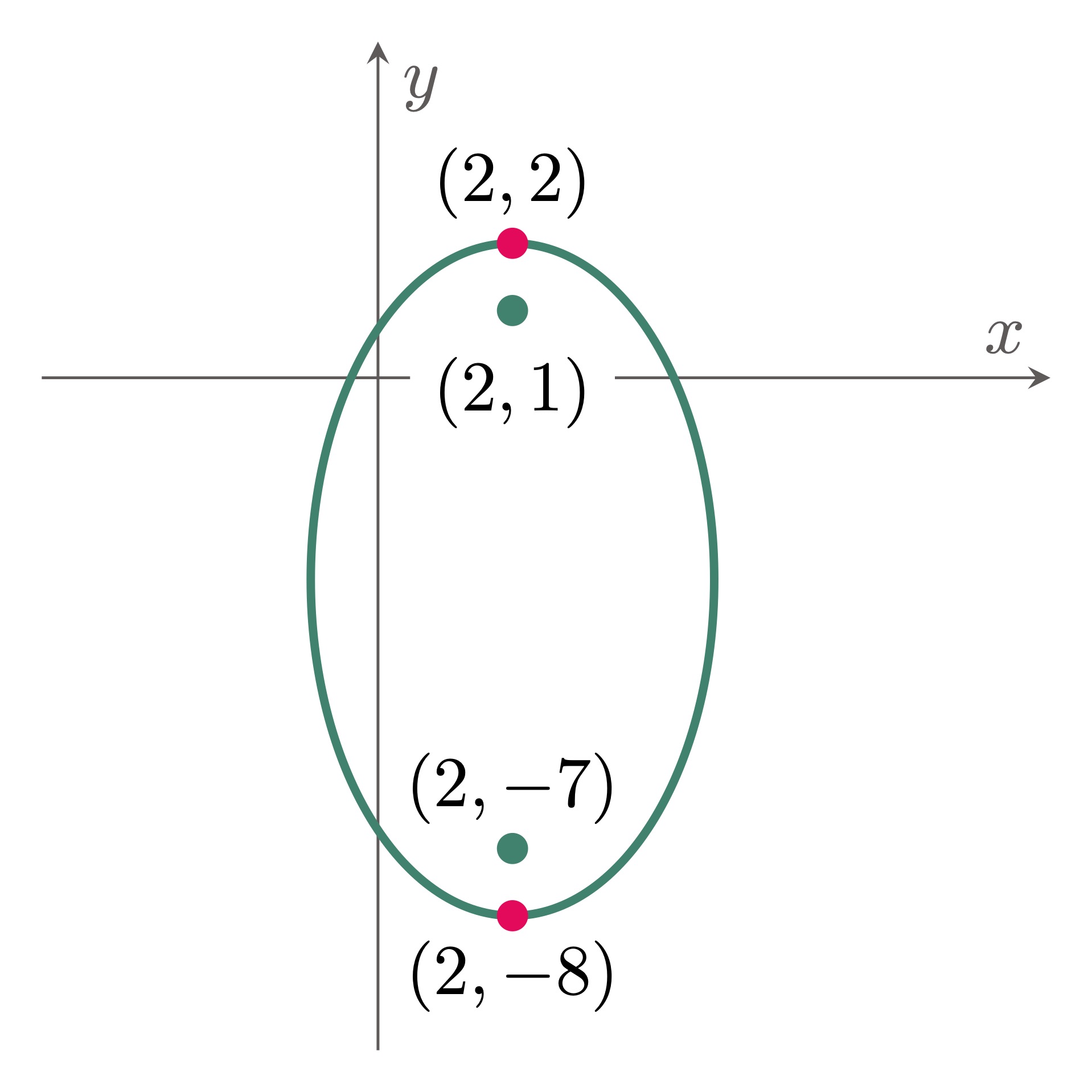
Since the $x$-coordinates of the given vertices and foci are equal, the major axis is parallel to the $y$-axis (the major axis is vertical). We can also see that the center is not in the origin. Hence, the equation that we will use is: \(\frac{(x-h)^2}{b^2}+\frac{(y-k)^2}{a^2}=1\)
The center $(h, k)$ of the ellipse can be obtained by getting the midpoint of the two vertices,
\[\begin{align*} (h,k) &= \br{\frac{x_1+x_2}{2}, \frac{y_1+y_2}{2}} \\ &= \br{\frac{2+2}{2}, \frac{(-8)+2}{2}} \\ &= (2,-3) \end{align*}\]The semi-major axis $a$ is half the distance between the vertices,
\[\begin{align*} a &= \frac{2-(-8)}{2} = 5 \end{align*}\]The foci of a vertical ellipse are at $(h, k \pm c)$. Using the focus $(2, 1)$,
\[\begin{align*} k + c &= 1 \\ c &= 1 - k \\ & = 1 - (-3) = 4 \end{align*}\]Using Equation~\ref{eq:ellipse relation},
\[\begin{align*} b^2 &= a^2 - c^2 \\ &= (5)^2 - (4)^2 \\ &= 9 \end{align*}\]Substituting $a^2 = 25$, $b^2 = 9$, $h = 2$, and $k = -3$ into the standard form,
\[\begin{align*} \frac{(x-2)^2}{9} + \frac{(y+3)^2}{25} = 1 \tagans \end{align*}\]General Form of the Equation of an Ellipse
The general form of the equation of an ellipse can be derived by expanding its standard form. In this form, the values of $h$, $k$, $a$, and $b$ are not immediately recognizable. Since both squared terms are present and their coefficients $A$ and $C$ are both non-zero and share the same sign, the general form of the equation of an ellipse is:
$$\begin{align} Ax^2+Cy^2+Dx+Ey+F=0 \end{align}$$
This is also consistent with the eccentricity of an ellipse, $e < 1$, which requires that $A \neq C$ but both are non-zero. When $A > C$, the ellipse has a vertical major axis. When $A < C$, the ellipse has a horizontal major axis. An important condition to remember is that for an ellipse, $A$ and $C$ must always have the same sign, that is, both positive or both negative. To recover the center and axes from the general form, rewrite the equation in standard form by completing the square.
$\example{3}$ Determine the coordinates of the center of the ellipse $9x^2+16y^2+18x-64y-71=0$.
$\solution$
Rewriting the equation in standard form by completing the square,
\[\begin{align*} 9x^2+16y^2+18x-64y-71 &= 0 \\ 9x^2+18x+16y^2-64y &= 71 \\ 9(x^2+2x)+16(y^2-4y) &= 71 \\ 9(x^2+2x+1)+16(y^2-4y+4) &= 71+9(1)+16(4) \\ 9(x+1)^2+16(y-2)^2 &= 144 \\ \frac{(x+1)^2}{16}+\frac{(y-2)^2}{9} &= 1 \end{align*}\]Comparing with Equation~\ref{eqn:ellip hk 1}, the center of the ellipse is
\[\begin{align*} C(-1, 2) \tagans \end{align*}\]Latus Rectum of an Ellipse
The latus rectum of an ellipse is a chord that passes through a focus and is perpendicular to the major axis. Its endpoints lie on the curve. The derivation of the length and coordinates of the latus rectum will not be presented in this module; the results are:
$$\begin{align} &\text{Length:} && \phantom{a} LR = \frac{2b^2}{a} &\\ &\text{Endpoints:} && \phantom{a} \br{c, \pm\frac{b^2}{a}} \end{align}$$
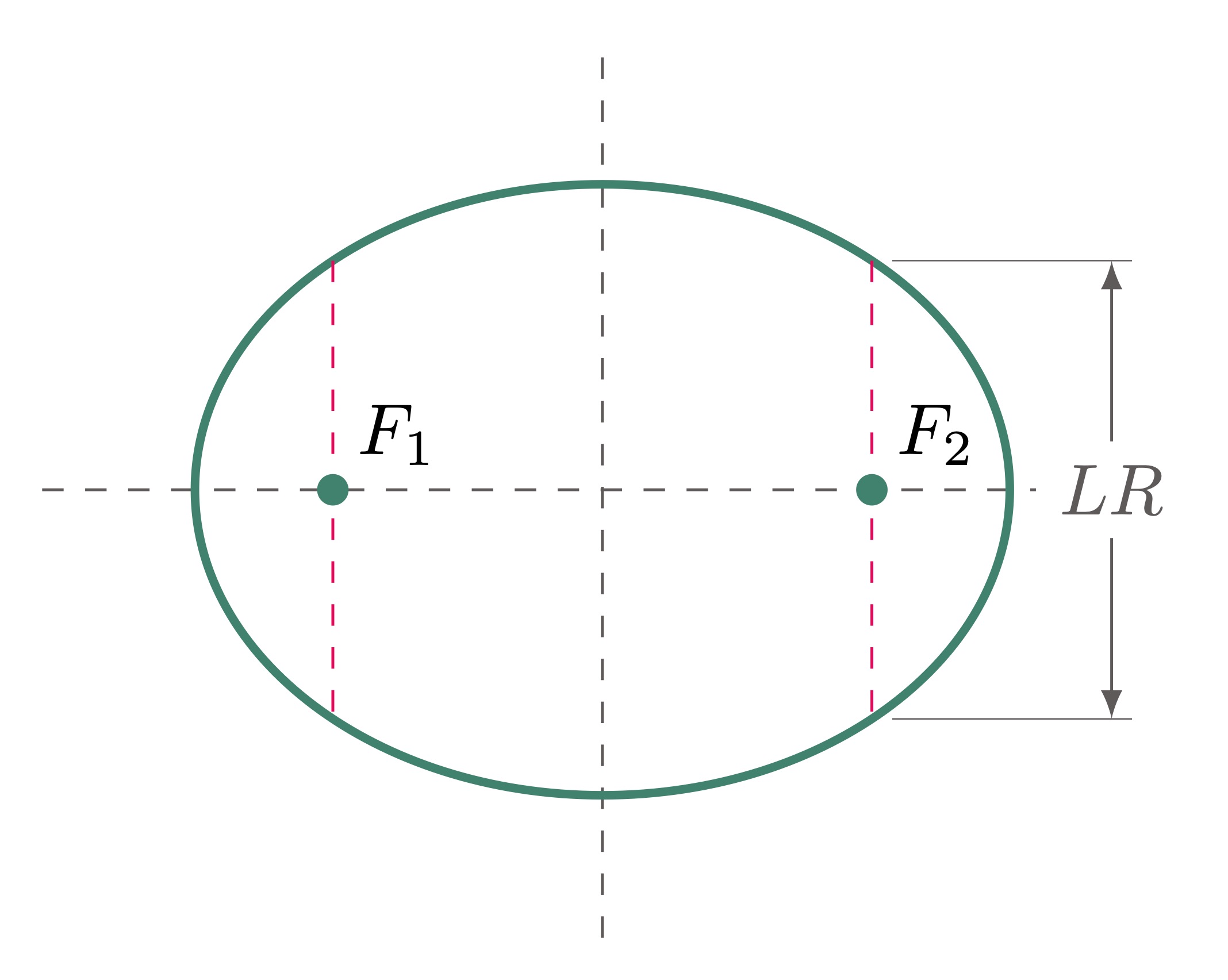
Figure 5: Latus rectum of an ellipse.
$\example{4}$ Find the length of the latus rectum of the ellipse $4x^2+9y^2-24x+36y-72=0$.
$\solution$
By completing the square, rewrite the equation in standard form,
\[\begin{align*} 4x^2+9y^2-24x+36y-72 &= 0 \\ 4x^2-24x+9y^2+36y &= 72 \\ 4(x^2-6x)+9(y^2+4y) &= 72 \\ 4(x^2-6x+9)+9(y^2+4y+4) &= 72+4(9)+9(4) \\ 4(x-3)^2+9(y+2)^2 &= 144 \\ \frac{(x-3)^2}{36}+\frac{(y+2)^2}{16} &= 1 \end{align*}\]Comparing with Equation~\ref{eqn:ellip hk 1}, the values of $a^2 = 36$ and $b^2 = 16$, giving $a = 6$ and $b = 4$. Substituting into the latus rectum formula,
\[\begin{align*} LR &= \frac{2b^2}{a} \\ &= \frac{2(16)}{6} \\ &= \frac{16}{3} \tagans \end{align*}\]Directrix of an Ellipse
Similar to the parabola, an ellipse also has a directrix — a fixed line used in defining the shape through its eccentricity. An ellipse has two directrices, one associated with each focus, and both are perpendicular to the major axis. For a horizontal ellipse with center at the origin, the directrices are located at
$$\begin{align} x = \pm\frac{a}{e} = \pm\frac{a^2}{c} \end{align}$$
and for a vertical ellipse, the directrices are horizontal lines at $y = \pm\frac{a^2}{c}$. The directrix is particularly useful in computing the eccentricity of an ellipse from its equation, as illustrated in the next subsection.
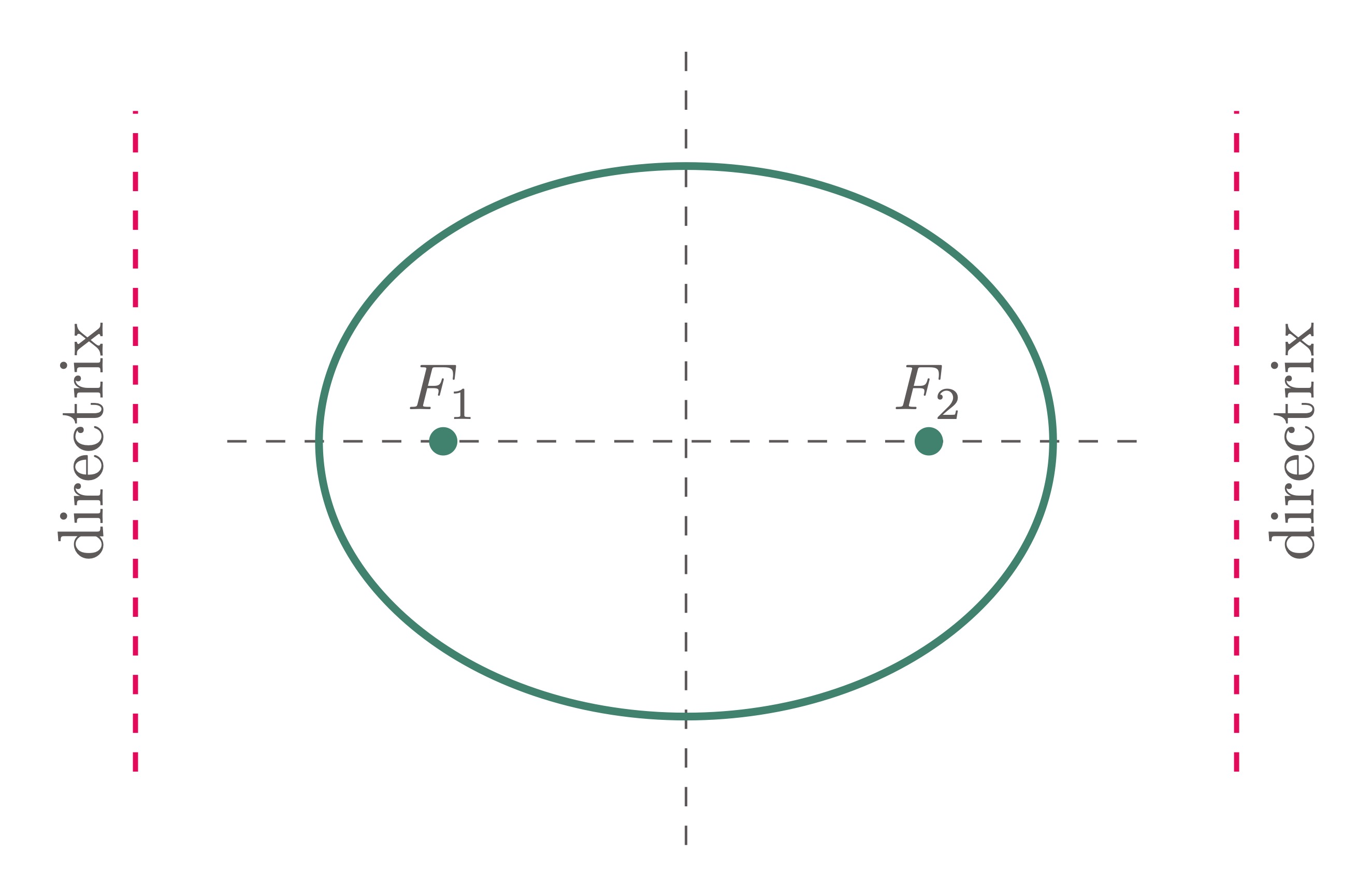
Figure 6: The two directrices of an ellipse, each perpendicular to the major axis.
Eccentricity of an Ellipse
The eccentricity of an ellipse is defined as the ratio of the distance from the center to a focus, to the distance from the center to the corresponding vertex. Since $c < a$ for any ellipse, the eccentricity is always less than one. Mathematically,
$$\begin{align} e = \frac{c}{a} \end{align}$$
As $e$ approaches zero, the foci move closer to the center and the ellipse becomes more circular. When $e = 0$, the ellipse is a circle. As $e$ approaches one, the ellipse becomes more elongated.
$\example{5}$ Determine the equation of the ellipse whose focus is at $(-1, 0)$, directrix is $3x+19=0$, and eccentricity is $\frac{3}{5}$.
$\solution$
Recall from Introduction to Conic Sections that the eccentricity is the ratio of the distance from any point on the conic to its focus, to the distance from that point to the nearest directrix, \(e = \frac{d_{PF}}{d_{PD}}\)
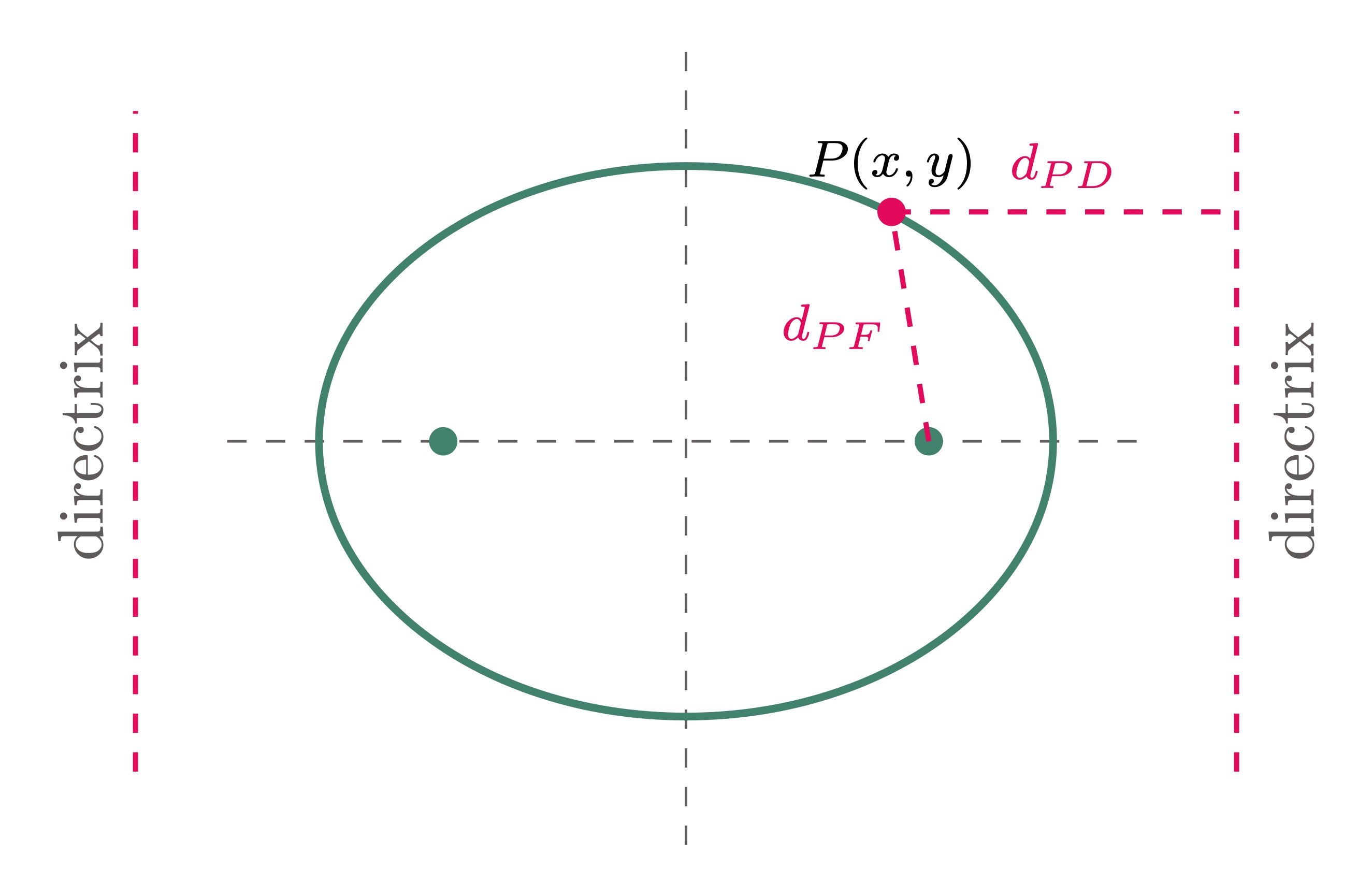
Figure 1:
Where $d_{PF}$ is the distance of point $P(x, y)$ to the focus, and $d_{PD}$ is the distance of the same point to the directrix.
Solve for $d_{PF}$, using distance formula:
\[\begin{align*} d_{PF} &= \sqrt{(x_P-x_F)^2+(y_P-y_F )^2} \\ &=\sqrt{(x-(-1))^2+(y-0)^2} \\ &= \sqrt{(x+1)^2+y^2} \end{align*}\]Solve for $d_{PD}$, using distance of a point to the line:
\[\begin{align*} d_{PD} &= \frac{Ax_1+By_1+C}{\sqrt{A^2+B^2}} \\ &= \frac{3x+19}{\sqrt{3^2+0^2}} \\ &= \frac{3x+19}{3} \end{align*}\]Substituting the values of $e$, $d_{PF}$ and $d_{PD}$:
\[\begin{align*} e &= \frac{d_{PF}}{d_{PD}} \\ \frac{3}{5} &= \frac{\sqrt{(x+1)^2+y^2}}{\frac{3x+19}{3}} \\ \frac{\cancel{3}}{5} \cdot {\frac{3x+19}{\cancel{3}}} &= \frac{\sqrt{(x+1)^2+y^2}} { \cancel{\frac{3x+19}{3}} } \cdot \cancel{\frac{3x+19}{3}} \end{align*}\]Square both sides of the equation, and simplify:
\[\begin{align*} \br{ \frac{3x+19}{5} }^2 &= \br{ \sqrt{(x+1)^2+y^2} }^2 \\ \frac{1}{25} (9x^2+114x+361) &= x^2+2x+1+y^2 \\ 9x^2+114x+361 &= 25x^2+50x+25+25y^2 \\ 16x^2+25y^2-64x-336 &= 0 \tagans \end{align*}\]