

A hyperbola is the set of all points on a plane where the absolute difference of their distances from two fixed points is constant. Each fixed point is called a focus of the hyperbola. Like the ellipse, every hyperbola has two axes of symmetry along which two important segments lie. The transverse axis passes through the center and has the $\tcB{\text{vertices}}$ as its endpoints. The conjugate axis is perpendicular to the transverse axis and has the $\tcB{\text{co-vertices}}$ as its endpoints. The foci lie on the transverse axis, and the center of the hyperbola is the midpoint of both axes, where they intersect, as illustrated in Figure 1b.
A key feature that distinguishes the hyperbola from the ellipse is the presence of asymptotes. Every hyperbola has two asymptotes that pass through the center and serve as the diagonals of the central rectangle — a rectangle centered at the origin whose sides pass through each vertex and co-vertex. To sketch the asymptotes, simply extend the diagonals of this rectangle, as shown in Figure 1b.
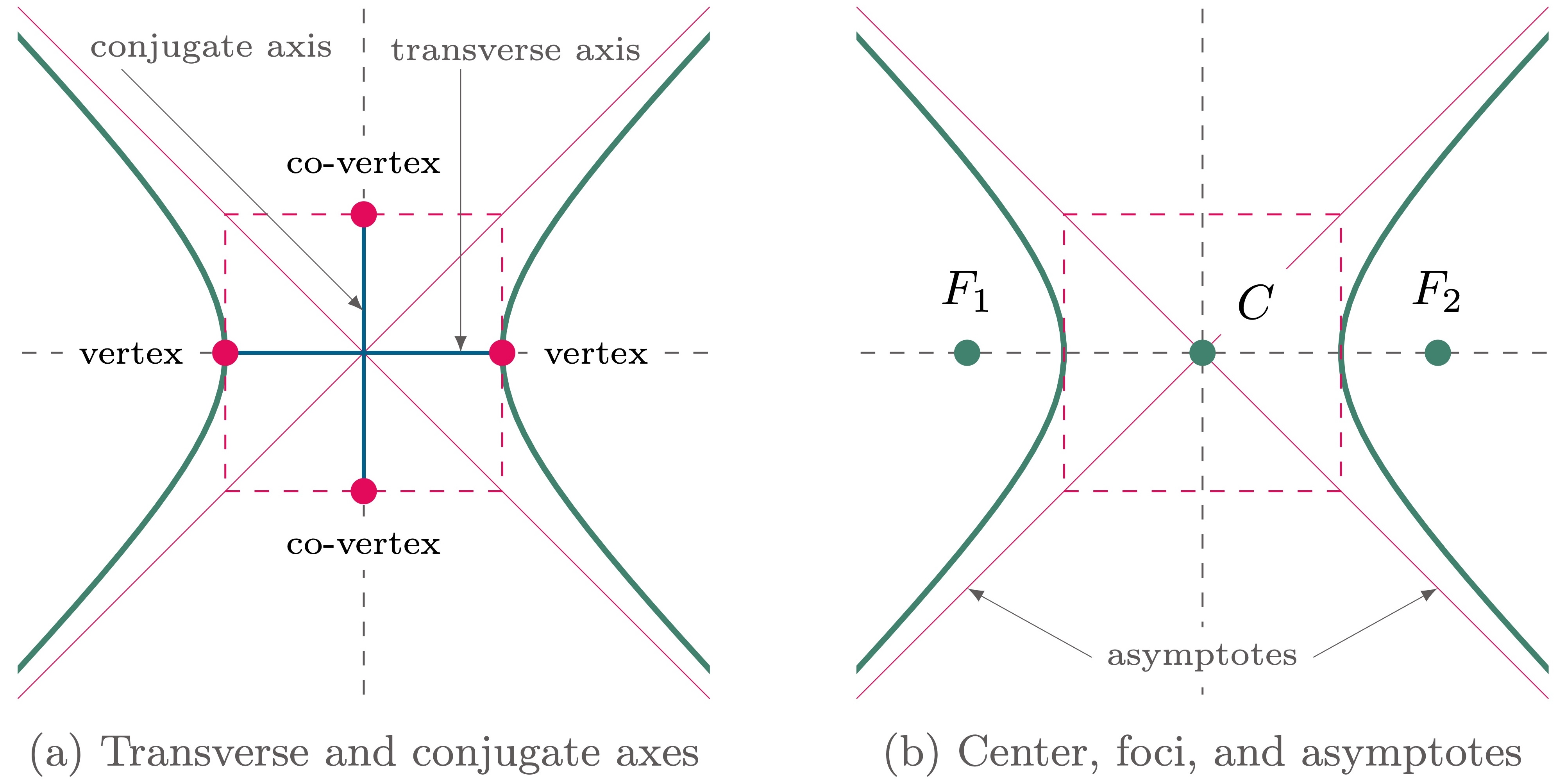
Figure 1: Basic parts of a hyperbola.
In this lesson, we will only consider hyperbolas whose axes of symmetry are horizontal or vertical. A hyperbola with a horizontal transverse axis is called a horizontal hyperbola, and one with a vertical transverse axis is called a vertical hyperbola.
Standard Form of the Equation of a Hyperbola
The derivation of the standard form of the equation of a hyperbola closely parallels that of the ellipse. Consider the hyperbola shown in Figure 2, with center at the origin and transverse axis along the $x$-axis. The parameters are defined as follows:
- $c$ — distance from the center to each focus, giving foci at $F’(-c, 0)$ and $F(c, 0)$
- $a$ — distance from the center to each vertex, giving vertices at $P(a, 0)$ and $P’(-a, 0)$
- $b$ — distance from the center to each co-vertex, giving co-vertices at $Q(0, b)$ and $Q’(0, -b)$
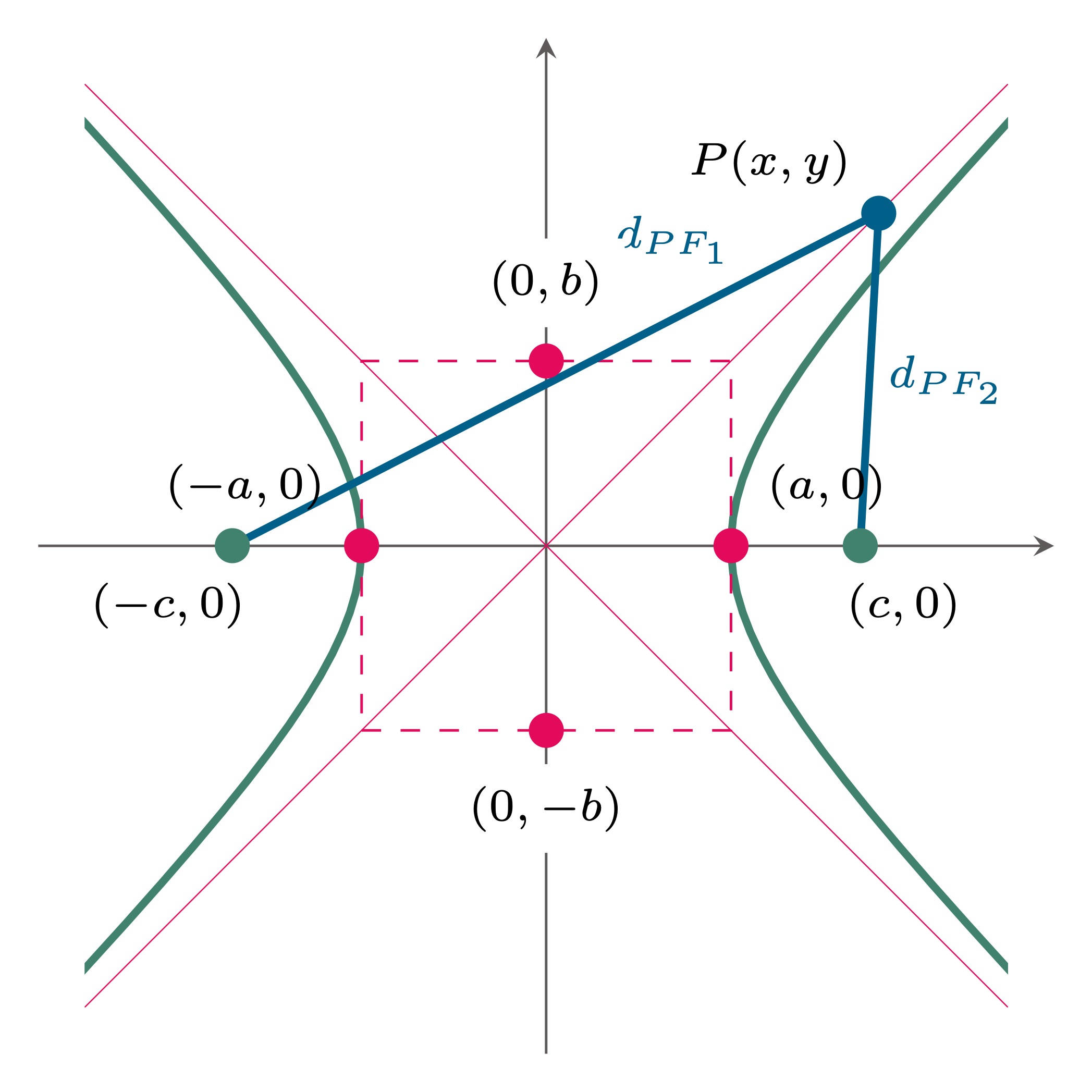
Figure 2: Hyperbola with center at the origin.
The key difference from the ellipse is that the hyperbola is defined by the absolute difference of distances rather than their sum. For any point $P(x,y)$ on the hyperbola, $|d_{PF_1} - d_{PF_2}| = \text{constant}$. Taking $P$ on the right branch and using the right vertex $(a, 0)$ as reference, \(d_{PF_1} - d_{PF_2} = (c+a) - (c-a) = 2a\)
So the constant difference equals $2a$, which is also the total length of the transverse axis. For an arbitrary point $P(x, y)$ on the hyperbola,
\[\begin{align*} d_{PF_1} - d_{PF_2} &= 2a \\ \sqrt{(x+c)^2+y^2} - \sqrt{(x-c)^2+y^2} &= 2a \end{align*}\]Isolating one radical and squaring both sides,
\[\begin{align*} \sqrt{(x+c)^2+y^2} &= 2a + \sqrt{(x-c)^2+y^2} \\ (x+c)^2+y^2 &= 4a^2+4a\sqrt{(x-c)^2+y^2}+(x-c)^2+y^2 \\ x^2+2cx+c^2 &= 4a^2+4a\sqrt{(x-c)^2+y^2}+x^2-2cx+c^2 \\ 4cx - 4a^2 &= 4a\sqrt{(x-c)^2+y^2} \end{align*}\]Dividing both sides by $4a$ and squaring again,
\[\begin{align*} \br{\frac{cx}{a} - a}^2 &= (x-c)^2+y^2 \\ \frac{c^2x^2}{a^2} - 2cx + a^2 &= x^2-2cx+c^2+y^2 \\ \frac{c^2x^2}{a^2} - x^2 - y^2 &= c^2 - a^2 \\ x^2\br{\frac{c^2}{a^2}-1} - y^2 &= c^2-a^2 \\ \br{\frac{c^2-a^2}{a^2}}x^2 - y^2 &= c^2-a^2 \end{align*}\]Dividing both sides by $c^2 - a^2$,
\[\begin{align*} \frac{x^2}{a^2} - \frac{y^2}{c^2-a^2} &= 1 \end{align*}\]Referring back to Figure 2, the central rectangle has sides $2a$ and $2b$, forming a right triangle in each quadrant with hypotenuse $c$ and legs $a$ and $b$. By the Pythagorean theorem, \(c^2 = a^2 + b^2 \quad \Rightarrow \quad b^2 = c^2 - a^2\)
Substituting,
\[\begin{align*} \frac{x^2}{a^2} - \frac{y^2}{b^2} = 1 \end{align*}\]This is the standard form of the equation of a hyperbola with center at the origin and a horizontal transverse axis. Applying the same process for a vertical transverse axis gives the following summary:
$$\begin{align} & \tcB{\text{Transverse Axis}} && \tcB{\text{Standard Form}} \nonumber\\ \hline \nonumber \\[-15pt] & \text{Horizontal} && \phantom{a}\frac{x^2}{a^2}-\frac{y^2}{b^2}=1 \label{eqn:hyperbola 0 1}\\ & \text{Vertical} && \phantom{a}\frac{y^2}{a^2}-\frac{x^2}{b^2}=1 \label{eqn:hyperbola 0 2} \end{align}$$
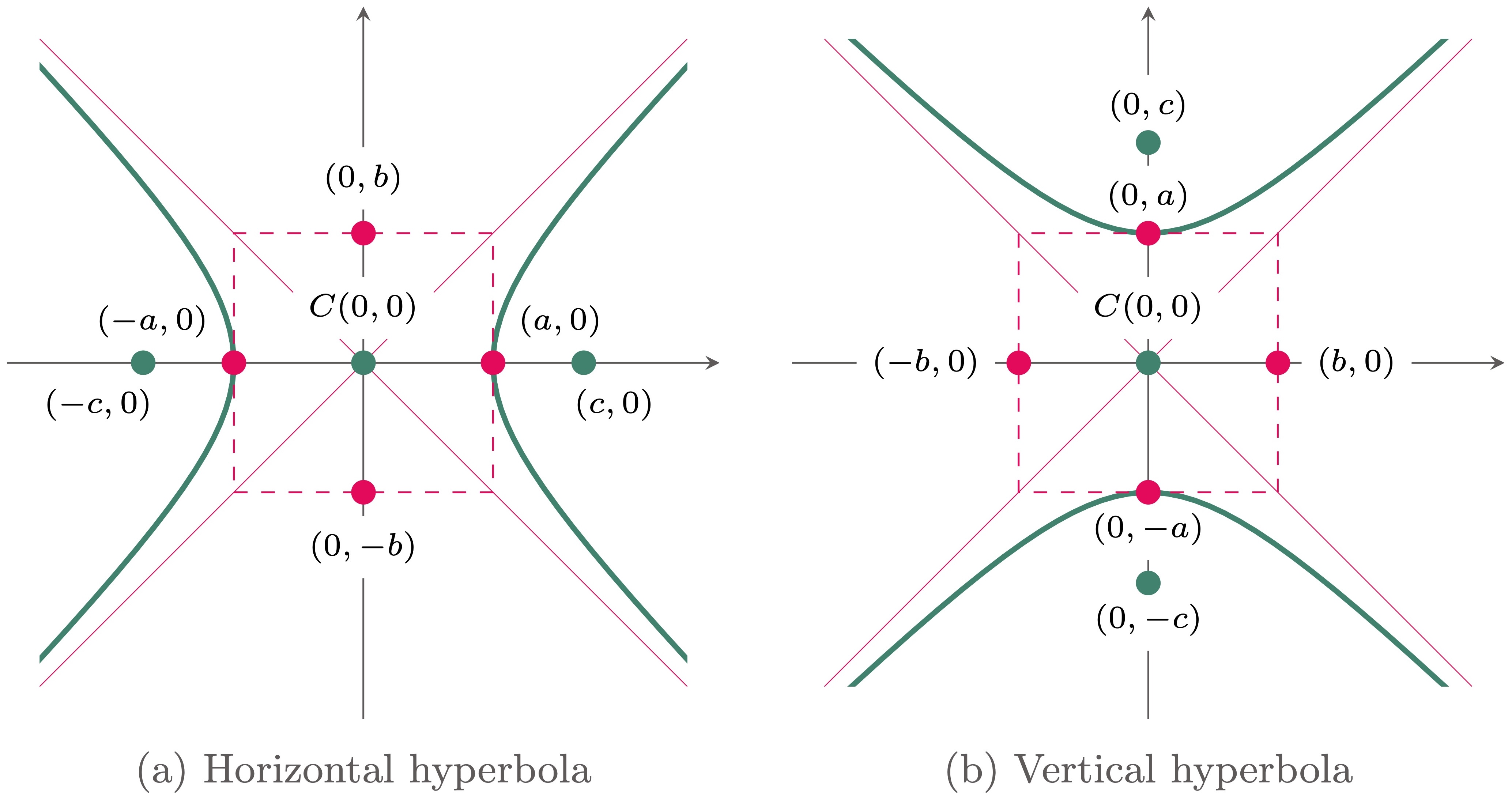
Figure 3: Hyperbolas with center at the origin $C(0,0)$.
For a hyperbola whose center is at $(h, k)$, the standard forms are obtained by translation of axes, as discussed in Section~\ref{sec:parabola}:
$$\begin{align} & \tcB{\text{Transverse Axis}} && \tcB{\phantom{aaaa}\text{Standard Form}} \nonumber\\ \hline \nonumber \\[-15pt] & \text{Horizontal} && \frac{(x-h)^2}{a^2}-\frac{(y-k)^2}{b^2}=1 \label{eqn:hyperbola hk 1}\\ & \text{Vertical} && \frac{(y-k)^2}{a^2}-\frac{(x-h)^2}{b^2}=1 \label{eqn:hyperbola hk 2} \end{align}$$
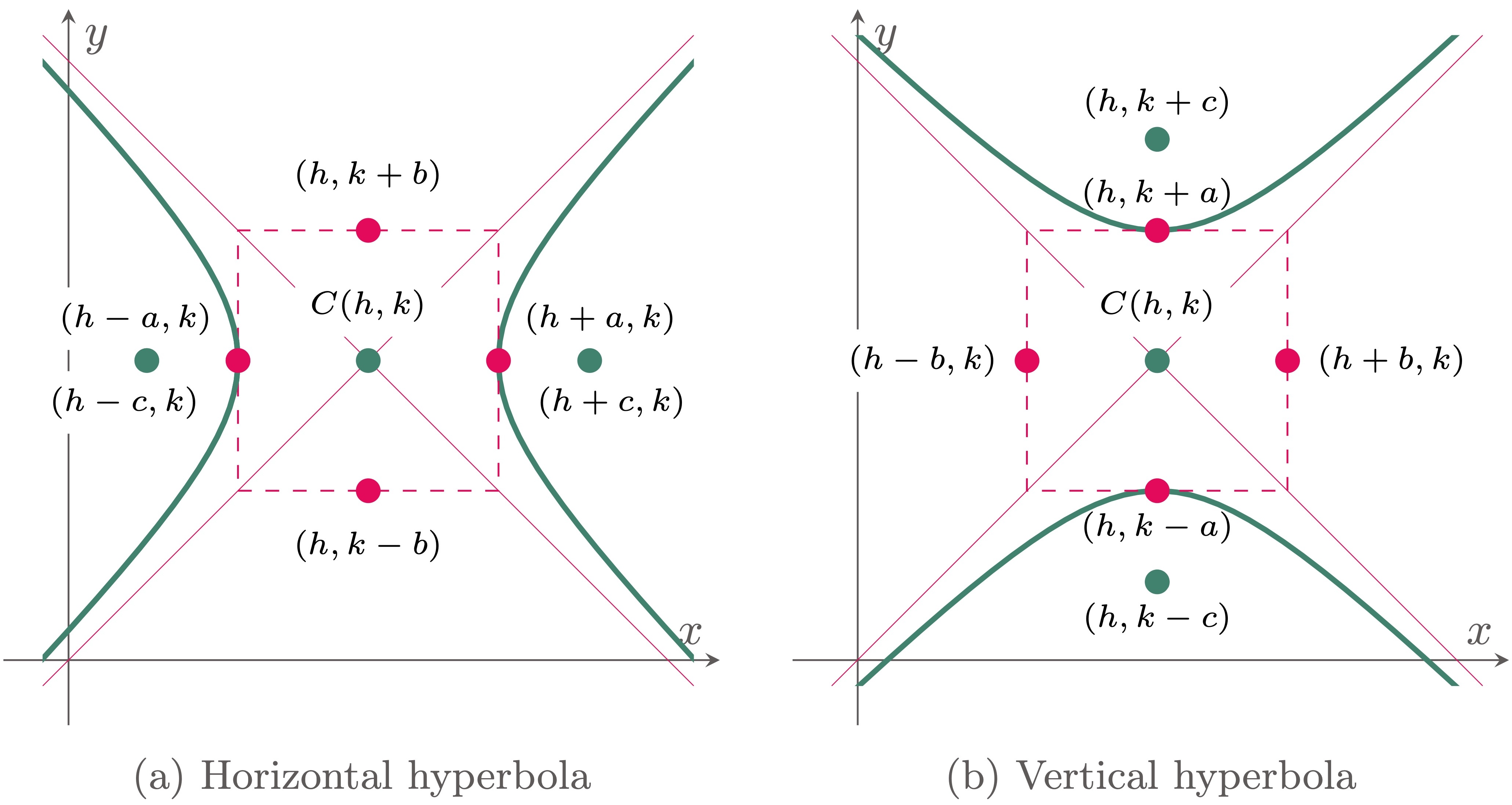
Figure 4: Hyperbolas with center at $C(h,k)$.
$\example{1}$ Determine the standard form of the equation of the hyperbola with center at the origin, vertices at $(0, \pm5)$, and foci at $(0, \pm13)$.
$\solution$
Since the vertices and foci lie on the $y$-axis and the center is at the origin, the transverse axis is vertical. Using Equation~\ref{eqn:hyperbola 0 2}, \(\frac{y^2}{a^2} - \frac{x^2}{b^2} = 1\)
The vertices are the endpoints of the transverse axis, so $a = 5$. Since the center is at the origin, the distance from the center to each focus gives $c = 13$. Using the relationship $b^2 = c^2 - a^2$,
\[\begin{align*} b^2 &= (13)^2 - (5)^2 \\ &= 169 - 25 \\ &= 144 \end{align*}\]Substituting $a^2 = 25$ and $b^2 = 144$ into the standard form,
\[\begin{align*} \frac{y^2}{25} - \frac{x^2}{144} = 1 \tagans \end{align*}\]$\example{2}$ Determine the standard form of the equation of the hyperbola with vertices $(-7, 2)$ and $(1, 2)$, and foci $(-8, 2)$ and $(2, 2)$.
$\solution$
Since the $y$-coordinates of the vertices and foci are all equal, the transverse axis is horizontal. Since the vertices are not symmetric about the $y$-axis, the center is not at the origin. Using Equation~\ref{eqn:hyperbola hk 1}, \(\frac{(x-h)^2}{a^2} - \frac{(y-k)^2}{b^2} = 1\)
The center $(h, k)$ is the midpoint of the two vertices,
\[\begin{align*} (h,k) &= \br{\frac{-7+1}{2}, \frac{2+2}{2}} \\ &= (-3, 2) \end{align*}\]The semi-transverse axis $a$ is half the distance between the vertices along the $x$-coordinates,
\[\begin{align*} a &= \frac{1-(-7)}{2} = 4 \end{align*}\]The foci of a horizontal hyperbola are at $(h\pm c, k)$. Using the focus $(2, 2)$,
\[\begin{align*} h + c &= 2 \\ c &= 2 - (-3) = 5 \end{align*}\]Using the relationship $b^2 = c^2 - a^2$,
\[\begin{align*} b^2 &= (5)^2 - (4)^2 \\ &= 9 \end{align*}\]Substituting $a^2 = 16$, $b^2 = 9$, $h = -3$, and $k = 2$ into the standard form,
\[\begin{align*} \frac{(x+3)^2}{16} - \frac{(y-2)^2}{9} = 1 \tagans \end{align*}\]General Form of the Equation of a Hyperbola
The general form of the equation of a hyperbola can be derived by expanding its standard form. In this form, the values of $h$, $k$, $a$, and $b$ are not immediately recognizable. Since the two squared terms have opposite signs in any hyperbola, the general form takes one of two possible forms:
$$\begin{align} Ax^2-Cy^2+Dx+Ey+F=0 \qquad\text{if } A>C \\ \text{or} \nonumber \\ Cy^2-Ax^2+Dx+Ey+F=0 \qquad\text{if } C>A \end{align}$$
This is also consistent with the eccentricity of a hyperbola, $e > 1$, which requires that $A$ and $C$ have opposite signs. When $A > C$, the hyperbola has a horizontal transverse axis. When $C > A$, the hyperbola has a vertical transverse axis. To recover the center and other properties from the general form, rewrite the equation in standard form by completing the square.
$\example{3}$ Determine the coordinates of the center, vertices, and foci of the hyperbola $9x^2-16y^2+36x+32y-124=0$.
$\solution$
Rewriting in standard form by completing the square,
\[\begin{align*} 9x^2-16y^2+36x+32y-124 &= 0 \\ 9x^2+36x-16y^2+32y &= 124 \\ 9(x^2+4x)-16(y^2-2y) &= 124 \\ 9(x^2+4x+4)-16(y^2-2y+1) &= 124+36-16 \\ 9(x+2)^2-16(y-1)^2 &= 144 \\ \frac{(x+2)^2}{16}-\frac{(y-1)^2}{9} &= 1 \end{align*}\]Comparing with Equation~\ref{eqn:hyperbola hk 1}, the center is at $(-2, 1)$, and the values $a^2 = 16$ and $b^2 = 9$ give $a = 4$ and $b = 3$. Using the relationship $c^2 = a^2 + b^2$,
\[\begin{align*} c^2 &= (4)^2 + (3)^2 \\ &= 25 \\ c &= 5 \end{align*}\]Since the transverse axis is horizontal, the vertices are at $(h\pm a, k)$ and the foci are at $(h\pm c, k)$. Substituting $h=-2$, $k=1$, $a=4$, and $c=5$,
\[\begin{align*} \text{center:} \quad & C(-2, 1) \tagans \\ \text{vertices:} \quad & (2, 1) \text{ and } (-6, 1) \tagans \\ \text{foci:} \quad & (3, 1) \text{ and } (-7, 1) \tagans \end{align*}\]Asymptotes of a Hyperbola
Every hyperbola has two asymptotes that pass through the center and extend along the diagonals of the central rectangle. To derive the equation of the asymptote for a horizontal hyperbola, consider Figure 5. The asymptote passes through the center $C(h,k)$ and through the corner of the central rectangle at the point $P(x,y)$. The slope of this line is the ratio of the vertical side $b$ to the horizontal side $a$ of the central rectangle,
\[\begin{align*} \frac{y-k}{x-h} &= \frac{b}{a} \\ y-k &= \frac{b}{a}(x-h) \\ y &= \frac{b}{a}(x-h)+k \end{align*}\]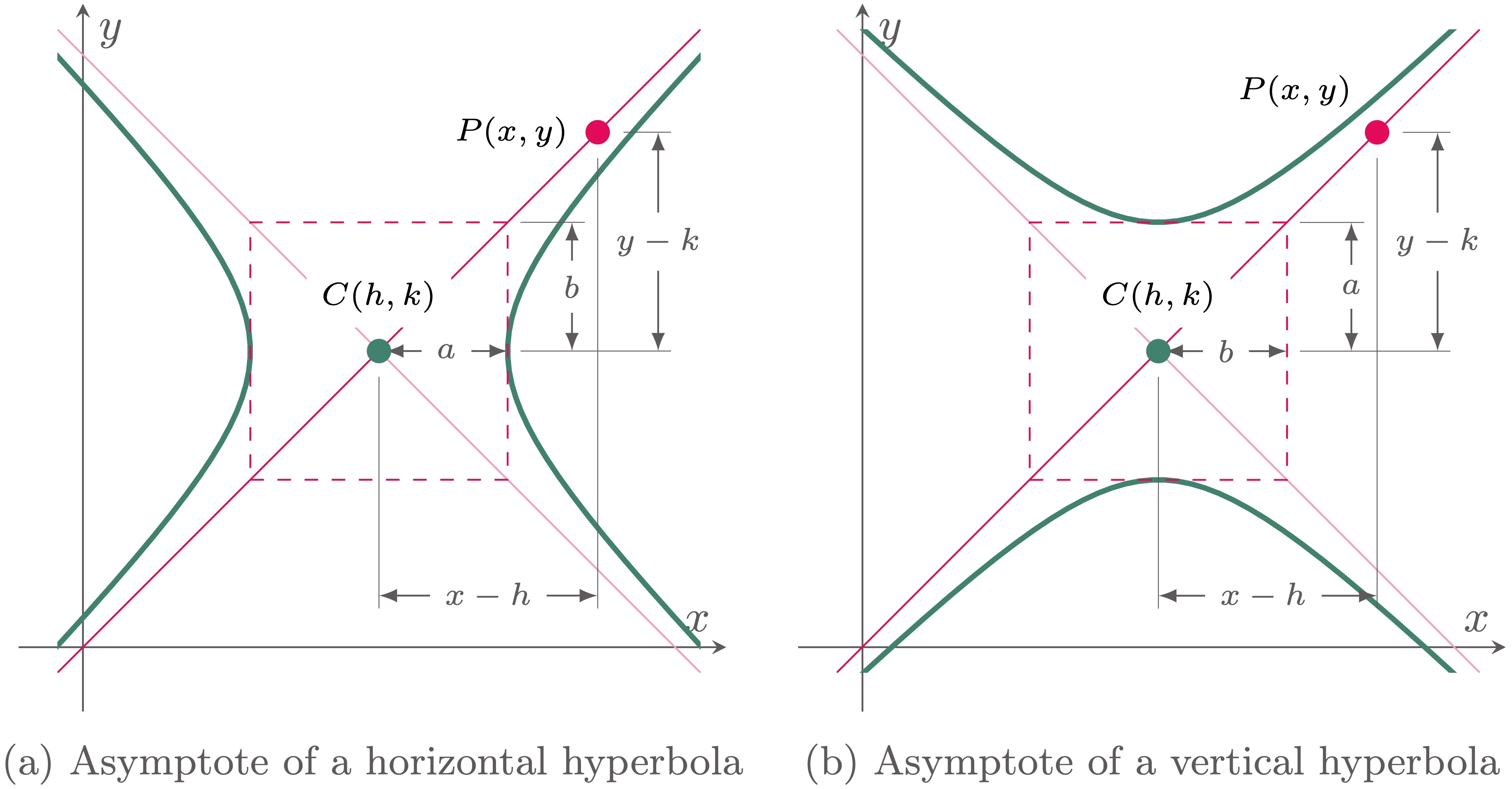
Figure 5: Asymptotes of a hyperbola with center at $C(h,k)$.
The second asymptote has the same magnitude of slope but opposite sign. Therefore the equations of the asymptotes for a horizontal hyperbola are:
$$\begin{align} y = \pm\frac{b}{a}(x-h)+k \end{align}$$
For a vertical hyperbola (Figure 5b), the roles of $a$ and $b$ are exchanged, giving:
$$\begin{align} y = \pm\frac{a}{b}(x-h)+k \end{align}$$
$\example{4}$ Find the equations of the asymptotes of the hyperbola $3x^2-2y^2+18x+15=0$.
$\solution$
Rewriting in standard form by completing the square,
\[\begin{align*} 3x^2-2y^2+18x+15 &= 0 \\ 3x^2+18x-2y^2 &= -15 \\ 3(x^2+6x)-2y^2 &= -15 \\ 3(x^2+6x+9)-2y^2 &= -15+27 \\ 3(x+3)^2-2y^2 &= 12 \\ \frac{(x+3)^2}{4}-\frac{y^2}{6} &= 1 \end{align*}\]Comparing with Equation~\ref{eqn:hyperbola hk 1}, the center is at $(-3, 0)$, $a = 2$, and $b = \sqrt{6}$. Since the transverse axis is horizontal, substituting into the asymptote formula,
\[\begin{align*} y &= \pm\frac{b}{a}(x-h)+k \\ &= \pm\frac{\sqrt{6}}{2}(x+3) \tagans \end{align*}\]Eccentricity of a Hyperbola
The eccentricity of a hyperbola is defined by the same formula as the ellipse,
$$\begin{align} e = \frac{c}{a} \end{align}$$
but for all hyperbolas $e > 1$, since $c > a$. When $e$ is close to one, the branches of the hyperbola are narrow. When $e$ is much greater than one, the branches become increasingly flat.
$\example{5}$ Find the equation of the hyperbola with vertices at $(-2, 15)$ and $(-2, -1)$, and eccentricity $e = \frac{17}{8}$.
$\solution$
Since the $x$-coordinates of the vertices are equal, the transverse axis is vertical. Since the vertices are not symmetric about the $x$-axis, the center is not at the origin. Using Equation~\ref{eqn:hyperbola hk 2}, \(\frac{(y-k)^2}{a^2} - \frac{(x-h)^2}{b^2} = 1\)
The center $(h, k)$ is the midpoint of the two vertices,
\[\begin{align*} (h,k) &= \br{\frac{-2+(-2)}{2}, \frac{15+(-1)}{2}} \\ &= (-2, 7) \end{align*}\]The semi-transverse axis $a$ is half the distance between the vertices,
\[\begin{align*} a &= \frac{15-(-1)}{2} = 8 \end{align*}\]Using the eccentricity formula to solve for $c$,
\[\begin{align*} e &= \frac{c}{a} \\ \frac{17}{8} &= \frac{c}{8} \\ c &= 17 \end{align*}\]Using the relationship $b^2 = c^2 - a^2$,
\[\begin{align*} b^2 &= (17)^2 - (8)^2 \\ &= 225 \end{align*}\]Substituting $a^2 = 64$, $b^2 = 225$, $h = -2$, and $k = 7$ into the standard form,
\[\begin{align*} \frac{(y-7)^2}{64} - \frac{(x+2)^2}{225} = 1 \tagans \end{align*}\]